Ratiocination versus The Age of Reason

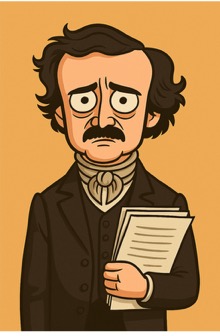
A cartoon of a person holding papers

AI-generated content may be incorrect.Although Edgar Allan Poe is most famous for his poetry and tales of the macabre, as an author he was so much more than that. The horror tales and poetry are but a tiny portion of a body of work extending to criticism of current events, literature, art, architecture and design; satire; historical fiction; proto-science fiction; travel narratives; and even serious mathematical[1] and scientific investigation[2].

He is, with justification, often cited as the creator of the modern detective story. His three tales featuring Auguste Dupin introduced the concept of the amateur investigator and an approach to solving mysteries (he called it “ratiocination”) that influenced nearly every writer of detective fiction since. But is there more going on here? His mysteries, and not just the Dupin stories, can also be viewed as explorations of the limits of the intellectual and scientific ideals of the Age of Reason and its dogma that reality can be fully explained purely through scientific observation and the application of human reason.

From a blog post on the Dupin stories, I found some interesting analysis, quoted from Murray Ellison’s Masters Thesis on “Poe and 19th-Century Science” (Virginia Commonwealth University, 2015). I would love to find that document to read it in its entirety, but the blog quotes it extensively, as I will also do here.

“A ratio compares the relationships between two quantities. Poe develops a new system for establishing relationships between unknown events and the motives or solutions to complex problems. Dupin expands the use of accepted nineteenth-century classical investigation techniques and adds hyper-observation and intuitive leaps of imagination to arrive at new solutions. He understands that clues and events are not always understood simply by the way that they appear.”

In his Dupin stories the formal investigative authorities represent the Enlightenment voice. Their failure to solve the crimes (which Dupin does, often from his armchair) demonstrates the limitations of their approach.

“With the same understanding of the evidence that the police hold, he provides new metaphoric solutions. His methods of unraveling crimes are unorthodox and appear to the police as irrational. Dupin presents the details of these cases directly or through an unnamed narrator to give readers a glimpse into his ratiocinative thinking … Dupin separates the relevant from the irrelevant. He focuses on unexplained deviations from the normal, anticipates the actions and thoughts of his associates and opponents, and embraces information that, at first, appears to be external to the case.” 

“As a non-professional detective, Dupin mocks the inferior crime-solving techniques of the paid Parisian police officials. The prefect appears in each of the Dupin stories and … thinks he has the perfect solution to the crime. However, Dupin is always skeptical of his approach and solutions.”

“The police are symbols for his criticisms of the professional scientists of the nineteenth century.”

Poe set the Dupin stories in Paris.

“Perhaps, he … made this choice because many French scientists and philosophers [of Poe’s time] epitomized Poe’s criticisms of these intellectual ideas of the nineteenth-century Age of Reason[3]. They rejected dogma and sought ways to find objective knowledge. They believed that truth could be best be verified by observation and scientific investigation. Among the ideas that Poe attacked in his detective stories was the irrational belief that man could ultimately attain near stages of perfection, and that he could control his environment [entirely] by scientific methods. Because of these contradictory views, it is hard to determine if Poe proposed ratiocination to address crime, or if he was mocking the irrational faith that the Age of Reason thinkers had in science.”

No one familiar with the vast range of Poe’s corpus of work would make the mistake of concluding that he was opposed to science and reason. His scientific writing is notably rational and often prescient. He even often used fiction to expose scientific hoaxes of his day and to provide well-reasoned explanations of the actual, scientific truth. 

“In his three tales of ratiocination, Poe demonstrates that Dupin’s methods of scientific reasoning are superior to those of the police. He is critical of the established authorities and power structures.  … He believes that scientists [of his time] are limited in arriving at new solutions in the same ways that the police are limited in solving crimes.” 

So, his view seems to be that while science and reason are critical, science and reason alone are insufficient. It takes a spark of genius that goes beyond mere observation and reason. Poe isn’t anti-science or anti-reason. He merely seems to have viewed that too absolute a reliance on the science of his day leaves important variables out of the equation.

Science has advanced mightily since the mid-19th century. The fruits of scientific observation and reasoning are accumulative and provide a far sturdier foundation for what is demonstrably knowable to work from, making it easier to avoid any shortcomings of the past. Perhaps his views are relevant only to a critique of the limited state that science had reached in his own day.

But one wonders what Poe would make of the state (and limits) of scientific advancement achieved today. And what hobby horses of hubris and limited thought would be the target of his critical skewers?

While generative AI has been used to create the accompanying graphic, I do not use AI tools in composing the content.


[1] Among his earliest paid journalism was a cryptography challenge, boasting that he could break any coded message submitted by the paper’s readers. “He received nearly a hundred secret messages from all over the country. Poe solved them all, except for one. And that coded message he proved to be ‘an imposition,’ a jumble of ‘random characters having no meaning whatever.’” (A Love of Mystery Is Woven into our Biology, and Edgar Allan Poe was the First to Find the Formula for a Very Specific Dopamine Hit.)

[2] Poe’s “Eureka” (1848) posits that the universe began from a singular, unified state and expanded over time, long before the formal development of the Big Bang model. Later scientific discoveries moot nearly all the details. He got “what happened” wrong, but some of Poe’s concepts align surprisingly well with modern cosmology.

[3] There is an alternative possibility. The source article also observes that Matthew Pearl, in his “Introduction” to the Dupin Mysteries, notes that “Poe introduced Detective C. Auguste Dupin, of Paris, France to literature more than five years before Boston had established the [United States’]  first professional police department.” 

Adaptive Leadership: It Will Never Be One-and-Done

I had the opportunity today to participate in a very stimulating ASAE Academy session on “The Adaptive Leader.” Some thoughts emerged …

To start with a statement of the obvious: organizations are more than their structured resources. They’re made up of people. And no matter how clear the mission and how abundant or well managed the systems and resources (financial, human, intellectual property, technology), it all is for naught if the people aren’t effectively supported, empowered, and engaged within the workplace.  

But people are complicated. They can’t be systematized. 

That challenge is not new, it’s just most severe today.

The session pointed out that, currently, there are five generational cohorts in the workforce. Now I am personally skeptical about generational categorization. I think length of experience in the workforce is a more determinative factor than year of birth. But the two things do largely correlate, so maybe that’s just semantics. My only caveat is that while any system of categorization can provide context, all are prone to over generalization. None provide an adequate and reliable solution that can be rigidly and uniformly applied to the leadership dilemma. 

So, regardless of how you categorize in order to try and understand them, there are many varieties of life experience in your workforce today. Each brings different needs, expectations and preferences to their role.

One thing is common to ALL of them: they are all coexisting in a workforce struggling to adapt to massive, recent disruptions that haven’t been fully resolved in an environment that continues to face new disruptions at a rapid and unrelenting pace. Things aren’t going to settle down and provide us more certainty any time soon.

There are the obvious external disruptions, from technology (including but not limited to AI), to changing market conditions and business imperatives, and combustible societal and political factors.

But many associations are all still coping with even the basics: an incomplete adaption to a post-COVID workplace and lack of comprehensive agreement on how we are meant to work today. And just as with generational categorization, here we are equally prone to oversimplify: is the “right” approach work from home, return to the office, or hybrid? And while hybrid seems to be the golden mean, exactly what hybrid form, structure, and processes are meant to apply eludes any clear and universally applicable judgment. Flexibility is desirable, but how flexible can we be, and meet both individual and organizational needs? There is no one right way, and many associations are still struggling to find theirs.

So we’re trying to get things right in unsettling and uncertain times. That is not a condition that is conducive to getting the best from people. 

To be sure, what we see in the workplace today is just the latest phase in a decades-long evolution from hierarchical, rigid structures of direct authority to more flat, collaborative hierarchies. In that sense, none of this is new.

But we are experiencing it in a particularly acute moment of disruption and uncertainty.

It is all happening so fast and on a massive scale.

The seminar left me with two, overarching take-aways;

  1. This isn’t going to be solved in a one-and-done manner. We all hunger for a fix that will last at least as long as the models they replace. But it won’t be that simple. It is a truism only because it is true: our only constant is change. We need to be adaptive today, tomorrow and consistently into the future. And the future is coming at us faster than ever.
  2. Senior management needs to be humble and self-aware. Staff is looking to us for a degree of clarity and certainty that, frankly, we cannot provide for them. While, with maturity, we may have a higher tolerance for ambiguity, senior management is also struggling to find the right norms of operation as a team themselves. And we are people too, just as vulnerable to doubts and uncertainty as people are in the structures lower down in the overly simplified concreteness intended to be conveyed in an organizational chart. 

But as leaders something more is called for from us. What we are called to do is approach these conditions with a reality-based, but constructive and positive attitude. Not naïve sophistry, but not defeatism either. Acknowledge rather than downplay or dismiss the validity of what people are feeling. But also act in firm assurance that, while we don’t have absolute answers to all their concerns now, this is solvable. 

That solution won’t come as edicts from on high; they will have to be crafted collectively. Something is called for from every member of staff, not just the c-suite. But the promise of reward is there.

Oh, and then there is the dynamic of effective leadership as a staff and the contiguous dynamic of effective leadership from voluntary governance.

It should be fun. It is certainly a challenge. 

While generative AI has been used to create the accompanying graphic, I do not use AI tools in composing the content.

Truth Under Fire

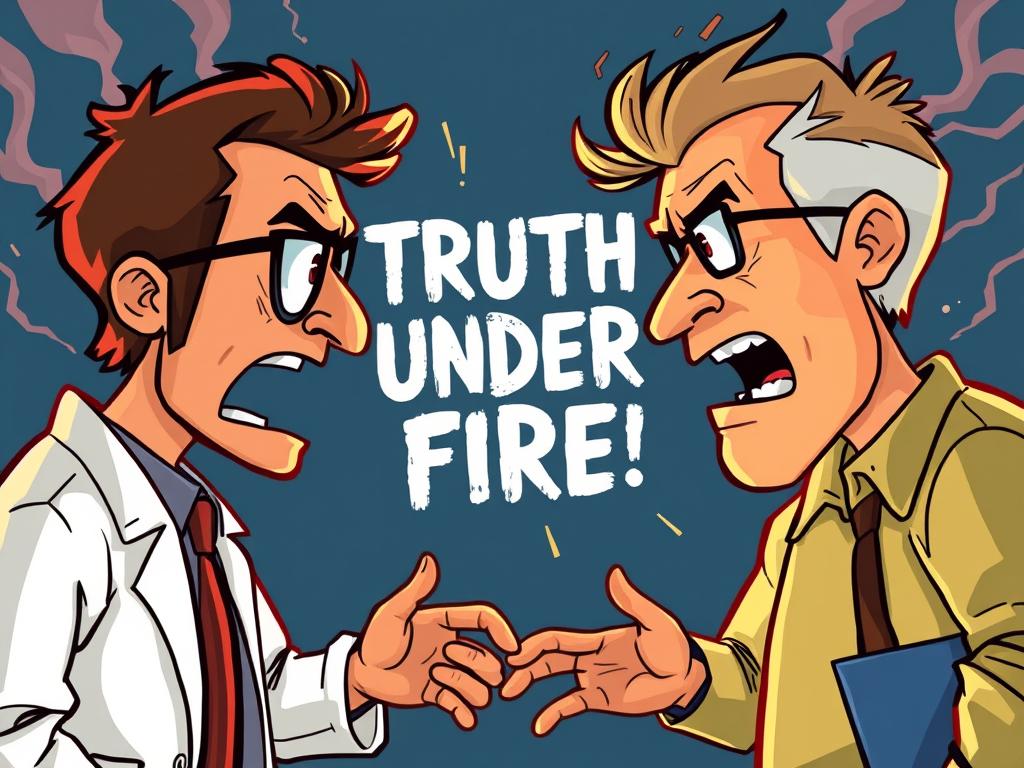
Associations (the good ones, at least) have always served society by providing a trusted and reliable source of information. That would seem to be the key role we have to play in our current environment of decentralized information, public distrust, and AI/social media-driven echo chambers that value divisiveness and conflict over reasoned dialogue. 

We (often rightfully) believe we have the hard, objective truth that the public and society so desperately needs. Why aren’t they listening? 

ASAE foresightworks, backed by rigorous methodology under the auspices of the ASAE Research Foundation, offers continuous strategic intelligence on drivers of change. Its latest release, “Truth Under Pressure,” offers useful clarity and actionable suggestions on this matter. To cite just one of its many insights: “As you convene members and constituents, you have an opportunity to advance open dialogue in pursuit of a common truth … Your [association’s] position as a credible convener could be compromised, however, when your events appear to be self-serving or pursue limited ideological agendas.” 

The same could be said about how associations collect, analyze, and communicate its truths, and, in particular, how we respond to misinformation when we see it. 

We are long past an environment where we can simply put out the data and trust the facts to speak for themselves. The truth demands effective advocacy.

Too often, however, no matter how pure our intentions and our intended tone, our advocacy is received as “You are wrong. Trust us. We know better than you do.” Even worse, too often, the message is communicated in overly aggressive language that communicates: “That’s misinformation and you’re an idiot for listening to it.”

That isn’t going to get us where we are trying to go.

I have recently been listening to a really impressive podcast, “Why Should I Trust You?” It regularly convenes prominent spokespeople for those promoting a “counter truth” around public health issues. It treats its guests and their points of view with respect. It doesn’t debate or attack their beliefs.  Instead, to quote the podcast’s website, “We hear from people who are wary about public statements, recommendations and studies coming from what they view as an elitist and conflict-riddled scientific establishment. And we hear from those in this establishment who fear the consequences of what they see as a dangerous trend towards anti-expertise.”

The podcast’s approach is subtle but strategic: they are not debates, fact-checking every point; rather, they move the group to a discussion of the outcome/concern we share in common: a public health system that better serves those who feel excluded or that they have been harmed by the current system. That allows a discussion that shifts from conspiracy theories that feed off justifiable fear and distrust due to their (negative) lived experience, to applying objective and sober statements of what is knowable that might actually address the source of their pain.

[My only caveat about the podcast. It rightfully refuses to reduce the dialogue to soundbites.  Just what is needed to get past trading slogans and memes. But, while thoroughly engaging, they are long. I fear there are people who are reachable but might not have the patience to listen.]

On a recent episode on autism, Holden Thorp, editor in chief of Science, observed: 

[Holden’s blog post on his participation in the podcast offers thoroughly reasoned arguments for the exact same point I am trying to make here.]

Let me clear, I am not advocating compromising our rigorous adherence to scientific truth but rather deploying it in a way that acknowledges the validity of the other side’s concerns. Not “me right; you wrong.” But “here’s something we know, specific and tailored to your specific concern, that might lead to the solution you are hoping for.” It isn’t about winning the war between my facts and your misinformation. It’s about applying what can be known, reliably, to fixing the thing that made you a no doubt well-intentioned but possibly counterproductive advocate in the first place.

The tweet-wars will no doubt continue. But if associations are to truly serve society, something more and something different is required.

Returning to ASAE foresightworks: 

While generative AI has been used to create the accompanying graphic, I do not use AI tools in composing the content.

Dark Days Shine New Light on Profession and Community

The National Society of Professional Engineers vision is “a world where the public can be confident that the engineering decisions affecting their lives are made by qualified and ethically accountable professionals. Professional Engineers (PEs) are involved in everything. They may not be the people the public sees on the front line, but they are always there, supporting and contributing to the quality of life of every person, every day, in important ways. Often, however, these contributions can only be fully appreciated after the fact.

At the time this is being written, we are in the midst of a global pandemic. By the time you read this, things will hopefully look much brighter and more hopeful.

Nonetheless, right now is a true test of the professional engineer’s commitment to health, safety, and welfare. PEs are uniquely qualified to address many of the problems faced by society in the wake of the coronavirus breakout. This is especially true as we move forward to a time of rebuilding to recover from the crisis. (And we will recover.) More importantly, it is true as professional engineers work to prevent something like this from ever happening again. It is important, now more than ever before, that we band together and use all the resources provided to us through our community.

This crisis has forced PEs to learn to carry on in new ways, when the traditional work environment has been taken away. And the professional engineering community has responded heroically. Every day they are continuing to do what they can, overcoming challenges and disruptions—and what they can do is proving to be a lot.

On the most basic, operational level, the staff and volunteers of the National Society of Professional Engineers (NSPE) are now routinely using technology and communications tools that have probably been on our devices for years, but we never used before. We’re learning how to use them effectively.

What we have learned about being more effective and productive under duress are skills we need to preserve and carry forward once life returns to normal, even as we reintroduce the vital element of direct human interaction.

NSPE itself is not immune from the impacts that have rocked the general economy and commerce in our country. Virtually overnight, streams of revenue have slowed or been cut off entirely; invested financial reserves have dropped precipitately in value; and there is no way to predict how long these conditions will prevail, or whether the worst might be yet to come. This event is bigger than NSPE: Each and every one of you is facing equally existential challenges to your families, your employers, your homes, your neighborhoods, your livelihoods.

But the organization has responded quickly, made difficult and often painful decisions, and implemented aggressive cost-saving measures across the board to ensure sustainability of operations in the face of these challenges. Those necessary steps are usually measured in dollars, but there is a human cost as well. We have made reductions in staff both in areas where the volume of activity is down and in areas where some level of value creation and delivery can be sustained, but at a reduced level. Remaining staff has made sacrifices, too, accepting reductions in salary, even as they are called upon to do more to make up for their colleagues who are no longer here.

But we remain focused on what this is all for: The mission of NSPE is too important to put on hold for a virus. Even as we all deal with difficult and disruptive times, NSPE leadership, volunteers, and staff are resolute and firmly committed to doing the very best we can to be there for our members and customers, delivering relevant and important benefits in this time of need.

All of it—the painful cuts as well as the adaptation to keep vital services flowing and to create new ways to support our members—are aimed at sustaining operations in the short-term, continuing to deliver maximum value wherever we can, and staying strong in order to seize the opportunities for rapid and vigorous recovery when this crisis is passed.

But at times like this, we are reminded that the national society alone isn’t enough; a state society alone isn’t enough. You need that entire network that includes all these elements. I have come to understand with new immediacy how right the NSPE strategic plan was to ground itself upon the concept of a single, integrated membership, supported by seamless services provided through state and national societies and local chapters in concert and collaboration—even when external circumstances make that unbelievably difficult.

But “network” is really just another word for community. Community is just an abstract word for a group of individuals. Interdependent and interconnected. Where benefit created anywhere benefits everyone, and harm suffered by anyone, anywhere, diminishes each of us.

Or, as John Donne put it nearly four centuries ago: “No man is an island entire of itself; every man is a piece of the continent, a part of the main; if a clod be washed away by the sea, [the whole] is the less.”

A plug for Beethoven and company in times of stress …

I was always someone who recognized the critical value of diligently providing for personal solitude as an element of leadership effectiveness. (There is a pretty good book on this subject if you are unconvinced: Lead Yourself First, by Raymond Kethledge and Michael Erwin).

The coronavirus pandemic would seem to have made solitude the new norm. But this enforced solitude is no guarantee of productive solitude.

Yes, we find ourselves in isolation, but the very technology that is the basis for sustaining some semblance of business continuity during this period of social distancing and stay-at-home orders (in my experience, at least) is actually increasing the noise and distraction. (How many hours did you spend on Zoom today?)

This 24/7 connectivity coupled with the natural yearning for human engagement is making it harder to do precisely what is demanded of us now as leaders in the face of such massive external disruption and existential personal and professional jeopardy. In crisis, our responsibility as leaders demands that we make space and step back to ensure that we are not merely reacting in the moment. Reflection is necessary to making difficult decisions wisely, with analytical clarity, creativity, emotional balance and moral courage.  

Exercise, meditation, prayer, and music are the frequent escape routes to such deep reflection.  

Many people who don’t normally listen to “classical” music may already be listening to it more in these stressful times. Its meditative qualities are obvious even if you know nothing about its nature, historical context, style or structure (as endlessly fascinating and absorbing as those things are to some people, myself included). 

If this is unfamiliar territory for you, a few words of advice to help you find your way.

First and most important: don’t buy into the big lie: that you need to study, learn and become an expert before you can enjoy or benefit from this music.  That is a fallacy promoted by cultural elitists to feed their need to feel superior. Music (all music) speaks directly to the soul and speaks in something other than words. Its power and content are accessible to anyone who is open to it.

True, the words used to describe the different forms and elements of classical music can be a little intimidating, like the unfamiliar language used to describe the offerings on a menu when you try a new style of restaurant for the first time.  But it need not frighten you. 

A symphony is just a single work for orchestra. It is made up of separate movements (often, but not always, four in number). Movements are just like chapters in a book.  

A concerto is really just a symphony with a featured solo instrument. Again, it is generally made up of multiple movements (often, but not always three in number), organized like chapters in a book.

A sonata is a single work for a specific instrument (without orchestral accompaniment) consisting of multiple movements. (The same term is also used to describe the internal structure of some musical forms, but you need not bother yourself with that.)

Nothing to be afraid of there. And nothing you really needed to know before tapping into the restorative potential of the music.

But I point it out only to make you aware that there is a reason the composer combined those separate “tracks” into a multi-part work. You can choose to read a single chapter in a book and find it edifying. Same with a single movement from a symphony, concerto or sonata. But realize that you are sampling just an excerpt of something larger.  The composer didn’t just throw random pieces of music together in random order and call it a symphony, any more than an author threw together random chapters in random order and called it a book. I’ll come back to this, but sometimes just an excerpt is like small plates in a restaurant – tasty, but you are missing the satisfaction of a planned, full menu, where carefully chosen appetizer is paired with salad, followed by a main course, and topped with dessert.  

Next, you are faced with the (very often Italian) words used as titles for individual movements within a larger work.  These are merely descriptions of the musical content of that “chapter.” Words like adagio, allegro, scherzo, etc. do have specific meanings related to the technical nature of the music. (Grossly oversimplifying: adagio means played slowly, allegro means played fast, scherzo means light and playful, and so on.) But again, you don’t need to know why its tagged that way to respond to the music itself. I only point it out because, it might be helpful in identifying more music from the vast classical catalog that you would like. (To use yet another food analogy, you don’t need to know that a specific seasoning or ingredient is what makes you like a particular dish so much. But knowing you like that ingredient could help you find new dishes you will probably also like.)

So here are my suggestion:

  • Look at the late 18th through the 19th century (generally labelled the classical and romantic periods). There are exceptions, of course, but the music of these periods is characterized by its accessibility. It has heavily influenced the music written for many movie soundtracks and if you loved Game of Thrones or Star Wars or Schindler’s List or The Godfather much of it will have a familiar feel.
  • Some people find earlier music of the 17th and early 18th centuries (the baroque period) more abstract, and some of it can be austere. But don’t hesitate to sample it. There is music of deep profundity to be found here too, as well as music of exquisite exuberance, if you need a pick me up.  (Again, the determining factor is what you respond to, not what some “expert” suggests you “need” to appreciate.) 
  • Go ahead and start with the big names (Beethoven, Mozart, Bach, etc.) and the popular hits so often packaged in those “100 Masterpiece” collections that used to be advertised on late night TV. There are reasons people who may have heard nothing else by Beethoven immediately recognize the opening of the fifth symphony. This is not a time for cultural snobbery – just because its popular doesn’t mean you lack musical refinement. It’s still great music.
  • Look for the adagios.  These aren’t the big, dramatic, heroic movements from longer works that you are most likely to have heard before. They are generally the gentlest, calmest and most soothing movement within multi-movement compositions.  Try, for example, the third movement of Beethoven’s ninth symphony (the “Choral” symphony) or the second movement of Beethoven’s fifth piano concerto (the “Emperor” concerto). Both are adagios.
  • If you find something that speaks to you, look for more by the same composer, or movements that are similarly labeled, or works in the same musical format. For example, if you find solo piano speaks to you more than orchestral works, stick with piano in your search. If vocal music sends you shrieking for the door, skip opera and stick with the orchestral stuff. If the adagio from one Mozart piano concerto appealed to you, most of his other 22 concertos also have an adagio movement you could check out.

These are useful signposts, not absolutes. Just because Mahler (who falls outside any of the historical periods of music cited above) wrote incredibly moving adagios doesn’t mean you’ll respond equally to anything else he wrote. Maybe Bach leaves you cold. That’s OK, too. Personally, I would feel impoverished without either of them. But that’s just me. You’re exploring what works for you, not seeking a degree in musical appreciation.

  • Finally, if you want to engage in the music as something more than a pleasant background soundtrack, once you have found your way into a larger, multi-movement work that speaks to you, continue on into the next chapter. That is, keep listening to the next track – the movement or section that follows your excerpt.  In the case of both the Beethoven adagios cited above, these serene movements lead naturally, organically and convincingly into the next movements, which are of considerable vigor and dramatic effect.  

That is instructive too, because we can’t just retreat and remain in solitude: having regained our equilibrium, these spiritual sabbaticals need to feed energy, focus and clarity into action, just as, in Beethoven, the dreamy adagio sets up the stormy and triumphant finale. 

[And a note begging forbearance from any reader knowledgeable about music. Every categorical statement above can be picked apart. Music is immensely vaster and more complex than these generalizations suggest. There are 20th century compositions as accessible as anything from the classical or romantic periods. There are obscure composers whose music is as accessible as anything Beethoven or Mozart ever wrote. There are scherzos that are anything but light and playful and adagios that are positively nightmarish. These are matters for connoisseurs to delight in; they need not create a barrier to those new to this music.]

Ending Missed Opportunites

A future-focused profession needs full participation from all people to reach its potential.

Diversity, equity and inclusion is a major theme interwoven throughout the National Society of Professional Engineer’s strategic plan. It was also recently enrolled into the NSPE Code of Ethics1. It is increasingly a strategic imperative for any future-focused, proactive profession or professional society. But it can also be a lightning rod for polarizing mischaracterization. So, what exactly is it that we are actually talking about?

Diversity simply means recognizing all the ways in which people differ. It must also recognize that individuals identify with and share multiple characteristics.

Equity is fair treatment and access to the opportunity for advancement for all people, while at the same time striving to identify and eliminate barriers that have prevented the full participation of some groups in the past.

Inclusion is the act of creating environments in which any individual or group feels welcomed, respected, and supported enough to fully participate.

Or, as the University of Michigan’s Robert Sellers more pithily put it: “Diversity is where everyone is invited to the party. Equity means that everyone has the opportunity to dance. Inclusion means everyone gets to contribute to the playlist.”

And these things matter. A 2015 study by McKinsey and Company documented that companies in the top quartile for racial/ethnic diversity are 35% more likely to have financial returns above industry norms. Top quartile companies in gender diversity are 15% more likely to outpace financial returns of less diverse players in the industry. Other studies have only reinforced these findings.

But understanding these matters requires a degree of self-awareness.

So, for the record, I am a white, male, over the age of 55, heterosexual, Christian, with no physical or mental disabilities; a natural-born American, college-educated, professional, who was raised in and continues to enjoy a comfortable economic life situation.

All of these attributes, and numerous others I could mention, contribute to who I am; none of them, taken individually, adequately capture my identity, that elusive but real thing that Dr. Martin Luther King Jr. so eloquently characterized as “the content of…character.”

Many of you may share one or more of the personal characteristics I opened with, but no two of us possess the exact same combination. An analogy to DNA comes to mind. The salient point is that each of us, whether or not we are aware or recognize it, are affected by our own, entirely unique combinations of them in how we think, act, behave, and form judgments.

Some of those characteristics are apparent or can be inferred by observation; many of those characteristics are hidden, and you wouldn’t know that about me unless I explicitly shared the information. Most important to this discussion, however, is that we all make assumptions based on the limited information that is available to us, and those inferences can be entirely wrong. How many of you, perhaps subconsciously, assumed that “Golden” meant Jewish, when in fact my family line back to at least the fifth century is Irish Catholic? It would be possible, if not particularly useful, to wear ribbons to declare what is hidden, but that’s not the point. We are all, each of us, a product of the sum of all of our individual characteristics, whether apparent through observation or hidden.

Let me further offer two concepts prone to being too simplistically understood. Both of these concepts are fraught. They can be and too often are weaponized for political purposes with destructive consequences. But they are nonetheless not only valid, but critical to these discussions.

First, unconscious bias.

Each of us, in any given situation, is driven by biases that are generally hidden and foreign to the other and even to ourselves. (Hence, the use of that modifier, “unconscious.”) And since, in any given situation, each of us is a unique combination of experience and natures, no two of us are influenced by the same set of biases. That is neither good nor bad, it merely is.

The second term is privilege.

Each of the characteristics that make up who I am and that covertly influence my behavior carries with it an accumulation over time of powerful societal and social consequences. These, again, will manifest differently for each of us.

And it would be disingenuous of me not to acknowledge that my particular catalog of identities is disproportionately rich in such privileges. That doesn’t take anything away from my personal accomplishments. Again, it merely is.

So, those are conditions on the ground: influences and consequences present in all our interactions and behavior, whether we wish to acknowledge them or not. It would be intellectually dishonest to deny it.

Barriers to women’s participation in the engineering profession are not new. Women now make up over half of the US population but constitute less than 20% of the bachelor’s degrees in engineering awarded in 2017. The number of women who enter the engineering education pipeline but never advance and enter the profession has remained stubbornly high, and the needle hasn’t moved much in decades. In NSPE’s membership, only approximately 10% are women.

The same can be said of underrepresented minorities. African Americans and Latinos constitute barely 12% of the engineering workforce (both licensed and unlicensed), compared to 35% of the total US population. In NSPE’s membership, approximately 17% fall in this category.

And from a membership perspective, attracting and engaging the next generation of engineers is a persistent problem. Approximately 60% of our membership is 50 years or older. What ominous signals does that send for our future?

But numbers and labels are merely the measurable attributes. Much as those of us in the engineering and scientific community love to reduce things to neat and formal systems that can be rationally manipulated and solved, diversity, equity, and inclusion must not be approached reductively. Therein lies the moral jeopardy at the root of some of the most horrific episodes in human history, when people—who, deep down, I truly believe are basically and fundamentally good—collectively made real evil a part of human society. It happened by reducing characteristics to equations that were coercively applied.

We are a product of history. None of the inequities, whether trivial or profound, at work in our lives came about overnight. Small injustices compounded over time and became institutionalized and even sublimated into our unconscious collective and individual biases.

It is important to recognize that, as a society (and for the most part, as individuals), we have made real progress, rising to the challenge and attacking the most pernicious effects of bias head on once we became aware of them at work around us. We have reduced but, alas, not eradicated them completely from their place in our unique personal and shared collective experiences. All of them continue to have some potential or actual continued influence and effect, even if their most ugly manifestations and oppressive elements have been eliminated. Anti-Semitism did not begin with the Nazis, nor did it vanish from us when that regime was crushed. Racial prejudice did not begin in the Jim Crow era in the second half of the last century, nor, alas, did it end with civil rights legislation.

But progress is possible and has been made; this too we must acknowledge.

And the trigger to positive further progress is awareness. We need to see and acknowledge the costs and missed opportunities that the biases at work in our personal, professional, and societal lives impose before we can address them.

Which brings me at long last to the National Society of Professional Engineers strategic plan’s inclusion of diversity, equity, and inclusion. What are the factors that needlessly inhibit or prevent some of the individuals who are vital to the future of the profession and our professional society from achieving full participation in that future? This is a question of both justice and self-interest. Where are the social and professional assets that are being left behind, assets that could be productively invested in our shared mission? And what can we do to unlock that potential?

We have progressed at least so far as to identify the challenge as it persists today and will manifest in our future. The positive reception that NSPE’s strategic plan has received demonstrates that our commitment to the ideal is real. We not only believe in it; we want it to be more than just a slogan on a bumper sticker.

Diversity, equity, and inclusion within NSPE and the engineering profession can be achieved without descending into blame and recrimination when we are aware of our roots but not trapped by them. Focused on the future. That is the task we have set for ourselves.

1 NSPE Code of Ethics for Engineers, Section III, Paragraph 1(f): “Engineers shall treat all persons with dignity, respect, fairness and without discrimination.”

A Tale of Two Paradigms

Paradigms are the frames of reference that filter our view of the world. They govern how we see things … and can blind you to realties that don’t fit your governing paradigm.

Take professional licensure. It’s a no-brainer, right? Some form of professional licensure has existed in America for lawyers since 1763, for physicians and dentists since the mid-1800s and for engineers since 1907. After all, if people are going to entrust their safety, liberty, property, health and general welfare to you, they have a right to expect you to be competent and ethical.

In fact, though licensure came (comparatively) late to engineering, I would argue licensure is needed for engineering, most of all. If you need a doctor or a dentist, you can look into his or her credentials before submitting to care; if you need a lawyer, you can look into his or her credentials before entrusting them with your case.

TexasBut when you send your child to school, who checked to ensure that the engineering of the utility services was done correctly? In 1937, an explosion at a school in New London, Texas, killed 300 people and severely injured another 300, many of them children. (Some estimates place the casualties as high as 1,000.) The cause of the explosion? Faulty engineering linked to cost saving actions taken by the school board. This tragedy was one of the motivating forces behind passage of Texas’ licensure law that same year.

When you drive on a road, enter an elevator, or cross a bridge, what assurance do you have that it was engineered competently? Licensing the professional practice of engineering is necessary because P.E.s have the knowledge to recognize risks that the public itself is not able to identify and not empowered to protect itself against.

The form of government established in the US Constitution reserves authority to license professions to the states.  And there are currently laws in each of the 50 United States (and its territories) that establish legally recognized standards of practice based on an engineer’s education, experience,examination, and (in most states) mandatory continuing education. Regulators, the profession, educators and examiners have worked cooperatively to establish a system intent on maximizing the uniformity of engineering standards and license mobility across the United States. Areas of professional practice reserved to licensed professional engineers are reasonably and narrowly defined and limited to those areas with implications for the public welfare.

Now, some may (and some have) argued that engineering licensure was vital in the bad old days, but that society, technology and education have evolved to such an extent that it is less important today.

History provides a steady stream of examples that prove such a thesis wrong. Take the 1986 space shuttle Challenger explosion, where engineering judgment was over-ruled by non-engineers. Or the 2010 Deepwater Horizon explosion and oil spill, where, under industrial exemption, P.E.s were not required but their involvement might have avoided the catastrophe. Or the 2015 Gold King Mine disaster, where authorities simply failed to employ a P.E. where it was clearly required and three million gallons of mine waste water and tailings were released into the Animas River.


There are too many more such examples that could be cited. Additional new ones can be expected in the future.

Moreover, there are still other areas where the value to the public that a P.E. could bring goes unrecognized: areas like autonomous vehicles, cybersecurity, even such mundane areas as amusement park rides and duck boat tours. Real world experience has proven how deadly the lack of competent engineering judgment in these fields can be. Their actual and potential vulnerabilities have all been covered in recent issues of PE magazine.

Surely the need for engineering licensure is self-evident, right?

But there is another, a different paradigm at work here.  Viewed from this perspective, licensure exists to protect licensees from competition, not the public from harm. Licensure is a barrier to economic growth, workforce development and investment. Ergo, alllicensure requirements should be challenged and removed.

It is a paradigm being aggressively pushed by well-funded and nationally-coordinated efforts of groups like the American Legislative Exchange Council (ALEC), the Koch brother’s Americans for Prosperity, the Institute for Justice, the Goldwater Institute, and others.

It is a paradigm that is gaining public currency, as can be seen in headlines, op-eds and media coverage from the Wall Street Journaland the Washington Post right down to your hometown newspaper.

Presentation1

And it is a paradigm that drove serious anti-licensure initiatives in legislatures in 31 states in just the past three years … and in 16 states so far in 2018 alone.

Map

Sometimes the P.E. is unintended, collateral damage in overly broad, occupational licensing and deregulatory efforts; increasingly, though, the bullseye is centered right on the P.E. itself.

The engineering community cannot afford to rest complacently in the comfort of its own paradigm. It cannot afford to deal with specific threats where they occur, and pat itself on the back when, as has luckily been the case so far, the specific threat is neutralized or mitigated.

We need to recognize that no single battle victory is ever final, that a bad outcome in any state is a danger in every state, and that rigid, knee-jerk defense of the status quo is insufficient. (Unfortunately, anti-licensure forces can cite examples of actual – albeit, trivial – over-reach by P.E. regulation and regulators that defy common sense.)

The now prevailing paradigm is against us. Unified, nation-wide action is required, action open to fundamental change to strengthen and improve the P.E. so that it can stand in the face of the new paradigm.

And that action must be sufficient to change the public’s perception from the license as a purely legal or regulatory obligation and bureaucratic nuisance to recognition of the value and need to use P.E.s even where the law (and industrial exemptions) don’t require it.

That is precisely the mission that NSPE (as an integrated network of national and state organizations) exists to serve.

True North

The following is adapted from remarks delivered at the National Society of Professional Engineer’s House of Delegates General Assembly, July 22, 2017 in Atlanta, Georgia.

round_compass_logo_400x400As NSPE ends one fiscal/program year and starts a new one, it would be typical to talk about the past year’s activity. That is worth doing:  we have a good story to tell, and NSPE’s accomplishments of 2016-17 are something we can all take pride in.  But that would be repeating a story that you have already been told, as it was happening.

Besides, it has all been neatly summarized the NSPE Year in Review: 2016-17, which is available online at:

www.nspe.org/review16-17

So I thought I would focus my remarks at a higher level.

Culture is defined by values: foundational, unchanging principles that define what we believe and that determine the choices we make in the face of an ever-changing day-to-day reality. It is our compass, if you will.

The actual course we chart may need to change in the face of external realities beyond our control, just as a storm may require a ship to take a different route than the one originally planned. Technological advancement allows us to abandon sailing ships as our mode of forward progress when better means (such as steam ships, airplanes, rocket ships) become available.

But true north remains a constant.

Culture trumps politics, rules, legislation, structure, even strategy. No amount of tinkering with a law, procedure, or regulation is sufficient if a culture has been abandoned, forgotten, or has become unhealthy. Progress and improvement are possible and absolutely necessary, but only if grounded in a culture that remains relevant and is informed by our shared, timeless and unchanging values.

NSPE’s founders understood this.

It has become a commonplace to observe that NSPE was originally founded to unite a community in order to establish PE licensure laws in all 50 of the United States and its territories. But this mistakes means for an end.  Licensure is merely the outward form that makes our core values and beliefs tangible in our world.

Those values are summed up nicely in NSPE’s Statement of Principles: Being a licensed professional engineer means more than just holding a certificate and possessing technical competence; it is a commitment to hold the public health, safety, and welfare above all other considerations.

That is not to say that we don’t need to continue to exert activist and diligent effort to define, promote and protect licensure rules and regulations. With the very concept of licensure under increased attack, those rules and procedures, tactics and strategies, legislation and regulation demand our vigilance and constant effort.

But I think it is instructive and useful from time to time to take our eyes off the licensure tree and remind ourselves of the forest we seek to nurture, grow and preserve: the professional community that is NSPE.

The new membership business model overwhelmingly approved by the NSPE House of Delegates at its General Assembly in Atlanta in July is another one of those means that should never be mistaken for an end. But the means are important.  Decisions on policy, strategy, and yes, even on the mundane details of the organization’s administrative and financial structure, have consequences.

For NSPE’s elected leadership, at the national and state levels, crafting this new approach to doing business required balancing the needs of a diverse membership and each member society in a manner that best serves the community as a whole.  All the internal operational matters that national and state leaders worked so hard to resolve were the necessary, if sometimes tedious obligation of leadership, but an administrative effort tied to a higher purpose and intention.

The new membership business model is a new vehicle, intended to re-energize, re-invigorate and restore a culture and ensure its viability and efficacy in a world that has changed much since the Society was established in 1934. But it is a vehicle that remains aligned to true north. It remains directed toward the same timeless truths that motivated the founders: that NSPE exists:

  • To protect engineers (and the public) from unqualified practitioners,
  • To build public recognition for the profession, and
  • To stand against unethical practices.

It recognizes that although the technical problems of each engineering specialty are divergent, the professional problems faced by engineers are alike. And that, while the technical societies, for the best fulfillment of their essential purpose, are divided on lines of differentiation, this division into separate organizations prevents effective united effort for the interests of the profession as a whole. Those aren’t my thoughts, or the current board’s. They are the principles articulated by NSPE’s founder, David Steinman, in 1934.

He went on to conclude that a “single national professional society, with solidarity of purpose and concentration of strength, is needed to provide effectively for the professional interests of the engineering profession” and that, to be successful, “unity and geographical organization are the essentials. The national society, the state societies, and the county chapters are closely and reciprocally integrated, and all are regarded of equal importance, with membership in one meaning membership in all.”

The new membership business model marks an evolution that revitalizes NSPE as a system of partners that are neither national-centric nor state-centric, but PE-centric.

The new membership model is not perfect – no product of fallible humans could be.  But it is the product of a serious and careful effort over the past year and a half to make the best decisions possible. And to the army of state leaders (staff and volunteer) for the hundreds of hours they have invested in designing the model, my sincere thank you.

And to all licensed professional engineers, whether members of NSPE or not, we’re just getting started. We’ve re-tooled our craft. We remain resolutely aimed at true north.  And we intend to blow you away with what we accomplish next.

The Power (and Limitations) of Social Media

swiming in dataAt a recent conference, I was diligent in my efforts to use social media to not only capture my own notes, but share them with my colleagues and associates, present and absent.  I got a decent amount of reaction and interaction for my efforts.  Retweets, likes, comments and discussion.  (Nothing remotely viral, mind you, but my efforts did not go unnoticed by the (in the grand scheme of the world) relatively small community of professionals who share my interests and concerns.)

I even got a tweet from a colleague whom I admire and who was not at the conference that my social media flow “made me feel like I was there and able to participate.”

I was simultaneously flattered and horrified by the reaction.

Flattered, because it suggested, perhaps, that I had been reasonably successful in a small but arguably impactful way in amplifying engagement and  advancing  the discourse of the brick-and-mortar event within the likeminded community who care about my profession and its future.

Gratified that the focus achieved through the laborious process of reducing insights to fit  the 140 character limits of the media seemed to have been successful.

Horrified to think that these soundbites, absent all the context, nuance and depth of the intellectual substance generated by the conference itself, could conceivably pass for (and be accepted) as remotely adequate or even marginally profound.

Frustrated that the limitations of capturing the idea is sometimes achieved at the expense of failing to give full or proper credit to the source of the insight.  Just because I tweeted it doesn’t mean the thought was mine.  But with a 140 character limit, there is only so much capacity to convey an idea and give proper credit where credit is due. (The media almost compel us to become involuntary plagiarists.)

And in my morning after moment, I am left wondering:  We live in a world where political engagement and news have already been reduced to soundbites, slogans and attention grabbing at the expense of substance, a process readily evident in the current presidential political campaigns and how they are covered.  This has replaced serious political discourse and deep engagement with achieving solutions to the complex issues and challenges that face us as a society.  News has evolved from “what bleeds, leads” to whatever can ignite passion is more important than advancing the dialogue in any meaningful way. That passion is not a bad thing; maybe it is even a critically necessary thing.  It is just insufficient if it fails to enable action that achieves actual solutions.  (It has been two years since #bringbackourgirls galvanized global attention … but those girls are still gone.) In politics, that passion can even be counterproductive to actually getting anything done and impede building any basis for consensus as a foundation for concrete action.

Maybe I am just sleep deprived and it will all look better tomorrow, but the question I am left with:  Have associations (or really any cause or mission-driven enterprise) become as attention-deficit benighted as our politics and news, and do we now accept that soundbites (slogans) that resonate actually do constitute sufficient wisdom and knowledge? Or constitute an actual accomplishment?

I do not want to in any way dismiss or disparage the sincerity and good will behind this new , social media reality … I just wonder whether it actually is getting us anywhere.

Or worse, creates an illusion of substance that enables complacency.

CEO effectiveness & volunteer boards

I was recently invited to share one piece of advice from what I have learned in my years as an association chief staff officer on effective partnership with volunteer leaders, for a book soon to be published by ASAE.  After giving  some thought to the matter, for me it came down to what JimiStock_puzzel Collins calls Level 5 leadership: “the paradoxical blend of personal humility and [fierce] professional will.” You need to be able to take your own ego-gratification out of the equation when assessing the association’s strategic needs, but also refuse to make allowances for any limitations that might be present on your board by compromising on the level of leadership their role demands from them. You need to be authentic in giving the board credit for association success and in truly owning any board failure as your own. And never, never, never, letting a setback cause you to doubt yourself or become tentative and risk averse. Take the hit, learn what you can from it, turn the page, and move on. In doing so, you become not only something of a safety net for the board, making it less risky for them to take bold action. You also model the behavior that will enable them to be effective in their own leadership roles.