The Staff > CEO > Board Relationship: A Matter of Perspective

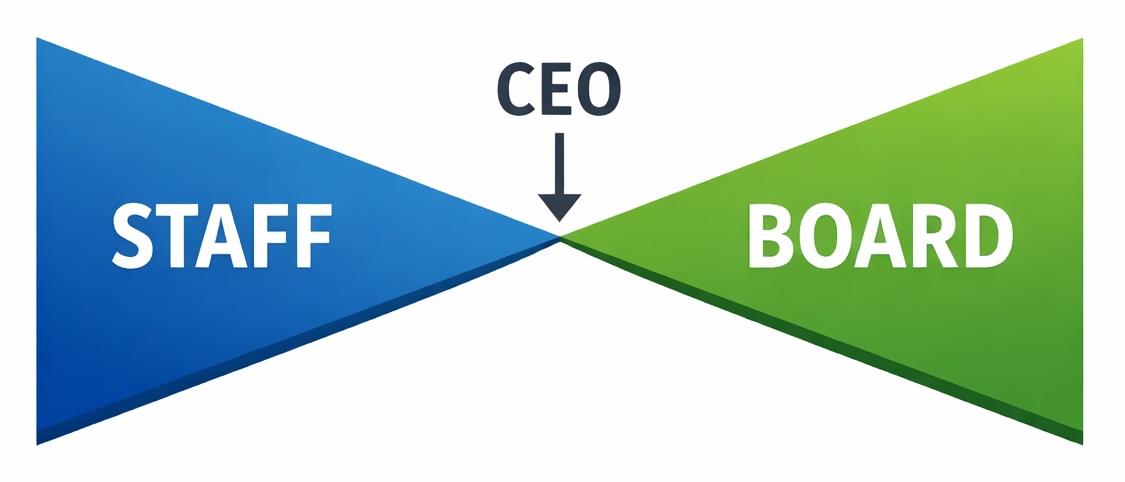
Last week I wrote about the association CEO’s unique position in governance, situated as it is between professional staff and voluntary directors/leaders. That focused on the CEO’s role in advancing a culture of stewardship at both the staff and voluntary levels. I received numerous comments from CEO colleagues who agreed with everything I said but raised a slightly different and potentially more problematic set of circumstances surrounding board/staff roles. (And I heard more than one horror story about where, in their experience, things went bad, in one case to the point of nearly costing the CEO their job.)

The basic principle is straightforward: the CEO is responsible to the board; all other staff are responsible to the CEO. Staff performance is itself a part of the accountability that the CEO has to the board. 

Most often, all staff hiring, firing, promotion, and compensation decisions are explicitly and specifically delegated exclusively to the CEO in his/her contract. And frankly, in my own experience, I have been pretty impressed by how seriously boards have shown respect for that separation of authority. They understand why it’s so important: the board can’t hold the CEO accountable for staff performance if the board is meddling in the CEO’s autonomy to exercise the authority necessary to building and maintaining a high-performing staff. 

Pretty straight forward in principle. But as my peers’ reactions to that column demonstrated, not always so clear in practice.

The Board’s Limited Perspective of Staff

Where the challenge can arise is a matter of the board’s limited perspective of staff.  Some staff positions are more member-facing than others. These are the staff members that voluntary leaders see and interact with directly. They have direct evidence of how well or how poorly such staff are performing those portions of their responsibilities that are visible to them. The problem is, they are forming a judgement based on only a limited perspective of that staff member. And they only see the pieces that touch them

Who Goes Unnoticed?

It’s why I always get so uncomfortable when the board wants to publicly recognize a member of staff for a job well done, even when such recognition is richly deserved. Now, I am all for recognizing and celebrating individual staff everywhere and in every way that it can be done. But when the board or a committee wants to single out the director of meetings for a successful conference, or the director of credentialling for the successful launch of a new certification, or the director of government relations for a legislative win, this can potentially set off negative ramifications elsewhere in staff. 

The board isn’t wrong in perceiving and wanting to acknowledge the performance of a staff member they work with directly. But they can only recognize the performance of the staff members they actually see. Who else goes unnoticed?  There are always others, in less directly member-facing roles who may have contributed as much or more to the accomplishment being recognized. 

There are also staff members whose roles are no less critical to the organization but are largely invisible to voluntary leaders. The only way they will ever come to the board’s attention is if something goes horribly wrong. 

When any staff member who had a material role in the success the board is celebrating are left out of recognition, and whenever a staff member or department feels unrecognized, they feel demotivated, unappreciated, and marginalized.

What Aspects of Even the Staff Members They See Are Hidden from Them?

And my colleagues pointed out an even worse case but not entirely uncommon scenario. There is a staff member the board or committee works with closely and continuously over a long period of time. That staff member is exceptional in the level and quality of support they provide the board or committee. Personal relationships are built. 

But they are seeing only the piece of an iceberg that is above the water. 

What if there are other, legitimate performance, skill, or behavioral issues going on underneath? 

Generally, these issues are minor and manageable. They might be uncomfortable and difficult for the CEO but buckle up. They can and need to be addressed. Most often, with a competent CEO, they are.

An Admittedly Extreme Example

But one particularly egregious case shared with me concerned a staff liaison who was truly extraordinary in meeting the member-facing aspects of his job. An absolute super star. But hidden from the voluntary component he supported were deeply problematic performance issues vis-à-vis this individual’s interactions with other staff. Persistent patterns of behavior that were contrary (and corrosive) to staff values and culture. And at so serious a level that other staff found ways to work around him rather than try to deal with him directly. He was that toxic an employee. 

As the CEO who shared this story put it to me, she had gone to great lengths to coach and develop the employee, providing training and support and encouragement that would allow him to correct his deficiencies and be truly successful at all levels of his job. She admitted that she went above and beyond the lengths she would have gone to with a staff member in a less member-facing role. Still, the employee’s behavior truly rose to a level where dismissal was warranted. But, my CEO colleague added, “how could I fire an employee so universally beloved by every member of leadership he ever supported?” 

Of course, one extreme case does not generalize to the commonplace. But it underlines the critical necessity for the CEO to cultivate a level of awareness, appreciation, and understanding by the board and other voluntary leadership that every staff member is an iceberg and they only see the piece above the water.

Building a Foundation of Trust

This is a matter of appreciating not just the principle at work but earning a solid relationship of trust by the board in the CEO’s judgement sufficient to weather the hopefully rare occasions when such a degree of trust is needed. Despite the cognitive dissonance between what the voluntary leader sees in the employee and the actions the CEO takes, do they have enough confidence in the CEO to accept on faith that he or she knows what they are doing, and that it is truly in the best interests of the organization?

As a CEO, by the time you are in the difficult situation, it is too late. Trust needs to be earned and banked before you need to rely upon it.

Disclaimer

The ideas contained here are my own. I do not speak for any organization or company.

AI was used to generate the image accompanying this post. I do NOT use AI to research, generate or edit drafts. 

The Board-Staff Disconnect

I have always viewed governance as the most critical role for the association CEO, and by governance I specifically mean the CEO’s function as the point of engagement between the board and staff.

There is an element of hierarchy to this, but org charts don’t adequately capture it. It’s a function of communication, coordination, facilitation and empowerment, to be sure. But it goes so much deeper than that. It is all about maximizing the synergy between the professional competencies unique to each side of the board/staff divide. The voluntary board and the paid professional staff each brings skills, knowledge, and expertise that the other lacks and the organization needs. The CEO alone operates in the shared space between them. The success of the enterprise lies on his/her ability to effectively engage with the board within their paradigm and engage with the staff within theirs. 

Most boards recognize and respect the differences between board and staff roles. But the established way of expressing these differences, while all valid, are also insufficient. To wit: 

  • The board sets direction and the professional staff implements. (Sometimes the metaphor of a bicycle is used: the board is the front wheel that steers; the staff is the rear wheel that drives.)
  • The CEO works for the board; all other staff work for the CEO.
  • The CEO leads operations; the board provides oversight.

Like I said, none of these are actually wrong. They are all just incomplete.

And there is evidence that the gap in understanding between boards and CEOs over the effectiveness of these conceptual models is very real. Spencer Stuart released a study that asked “Do you feel the board gives the CEO effective support to address a rapidly evolving and complex business environment?” 43% of boards answered yes, but only 22% of the CEOs did. And in no universe would even the higher number be a passing grade.

So what is missing?

A recently concluded, 18-month community dialogue into the Future of Association Boards (FAB) offers some insight.

Stewardship

First and foremost: There is a missing element in most measures of performance and success. That element is an overarching and explicit commitment to stewardship. 

It’s not about focusing on progress toward established goals (too often captured in strategic plans that end up being fuzzy, aspirational statements burdened with tactical “solutions” that fail to actualize them in a rapidly changing world). It’s not about a glowing “year in review” summarizing accomplishments. Even less about a chief elected officer being able to talk about the accomplishments of “his or her year in the chair.” And of course, you want to be able to do all those things authentically. 

Stewardship is something more. It is about leaving the organization itself better than you found it, for the benefit of both current stakeholders and their successors in membership, on the board, and in the field.

It isn’t that a sense of stewardship has necessarily been absent. It is just that it has too often been one of those “understood” and unspoken obligations and too often taken for granted. It needs to be brought out of the shadows and made an explicit and driving force in every decision.

Foresight

The key to effective stewardship is exercising foresight: more time focusing on anticipating and understanding the next disruption that, if missed, could mean an opportunity squandered or a blow to be suffered. The American Society of Association Executive’s ForesightWorks is a rich source for understanding and framing the kinds of discussions associations should be having.

Foresight has implications for programs and initiatives, but also for the governance structures created to support them.

True Partnership

The key to making stewardship and foresight happen is a higher degree of partnership between boards and staff than exists today. And the key to making that happen starts with a clearly stated and shared commitment between the chief elected and the chief staff officer:

  • With the chief elected officer accepting primary responsibility for improving board competence and performance[1] and 
  • The chief staff officer (and their senior management team) accepting primary responsibility for doing more than advising boards on issues within their specific functional roles, but as meaningful collaborators in the board’s exercise of stewardship and foresight.

And let me be clear: while there are ways that boards need to change[2], the accountability lies squarely on the CEO to create the means and opportunity for this happen. 

Circle back to my opening thought of the CEO as the person with a foot in both the voluntary and professional staff worlds. That’s the tough assignment we all signed on for.

Disclaimer

The ideas contained here are my own. I do not speak for any organization or company.

AI was used to generate the image accompanying this post. I do NOT use AI to research, generate or edit drafts. 


[1] How often can board members end their term in office feeling like the next person in the seat is joining a board better equipped to be even more effective?

[2] While we typically talk about “volunteer boards,” the FAB dialogue brought focus to the fact that while accepting service on a board is voluntary, once you have accepted that role the legal, fiduciary and ethical obligations to the organization (including stewardship and foresight) are the same as those for paid directors of for-profit corporations. That’s why an awareness of voluntary leadership’s accountability for stewardship and foresight is so important.

Adaptive Leadership: It Will Never Be One-and-Done

I had the opportunity today to participate in a very stimulating ASAE Academy session on “The Adaptive Leader.” Some thoughts emerged …

To start with a statement of the obvious: organizations are more than their structured resources. They’re made up of people. And no matter how clear the mission and how abundant or well managed the systems and resources (financial, human, intellectual property, technology), it all is for naught if the people aren’t effectively supported, empowered, and engaged within the workplace.  

But people are complicated. They can’t be systematized. 

That challenge is not new, it’s just most severe today.

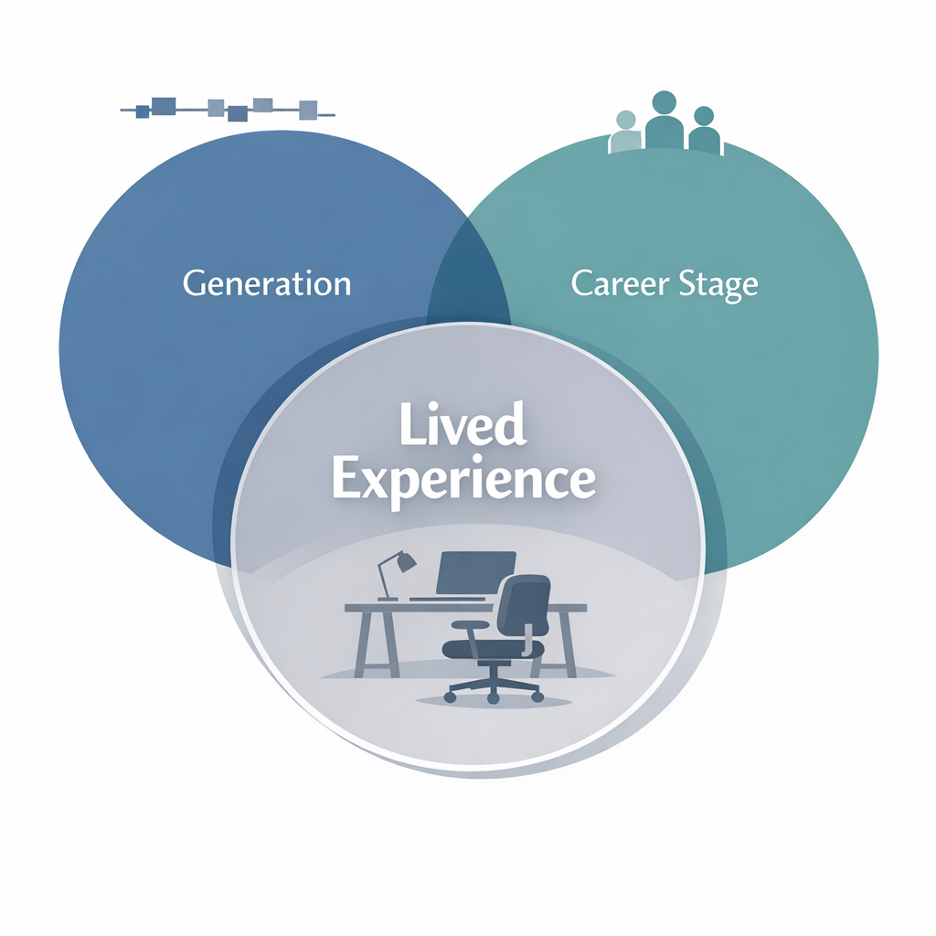
The session pointed out that, currently, there are five generational cohorts in the workforce. Now I am personally skeptical about generational categorization. I think length of experience in the workforce is a more determinative factor than year of birth. But the two things do largely correlate, so maybe that’s just semantics. My only caveat is that while any system of categorization can provide context, all are prone to over generalization. None provide an adequate and reliable solution that can be rigidly and uniformly applied to the leadership dilemma. 

So, regardless of how you categorize in order to try and understand them, there are many varieties of life experience in your workforce today. Each brings different needs, expectations and preferences to their role.

One thing is common to ALL of them: they are all coexisting in a workforce struggling to adapt to massive, recent disruptions that haven’t been fully resolved in an environment that continues to face new disruptions at a rapid and unrelenting pace. Things aren’t going to settle down and provide us more certainty any time soon.

There are the obvious external disruptions, from technology (including but not limited to AI), to changing market conditions and business imperatives, and combustible societal and political factors.

But many associations are all still coping with even the basics: an incomplete adaption to a post-COVID workplace and lack of comprehensive agreement on how we are meant to work today. And just as with generational categorization, here we are equally prone to oversimplify: is the “right” approach work from home, return to the office, or hybrid? And while hybrid seems to be the golden mean, exactly what hybrid form, structure, and processes are meant to apply eludes any clear and universally applicable judgment. Flexibility is desirable, but how flexible can we be, and meet both individual and organizational needs? There is no one right way, and many associations are still struggling to find theirs.

So we’re trying to get things right in unsettling and uncertain times. That is not a condition that is conducive to getting the best from people. 

To be sure, what we see in the workplace today is just the latest phase in a decades-long evolution from hierarchical, rigid structures of direct authority to more flat, collaborative hierarchies. In that sense, none of this is new.

But we are experiencing it in a particularly acute moment of disruption and uncertainty.

It is all happening so fast and on a massive scale.

The seminar left me with two, overarching take-aways;

  1. This isn’t going to be solved in a one-and-done manner. We all hunger for a fix that will last at least as long as the models they replace. But it won’t be that simple. It is a truism only because it is true: our only constant is change. We need to be adaptive today, tomorrow and consistently into the future. And the future is coming at us faster than ever.
  2. Senior management needs to be humble and self-aware. Staff is looking to us for a degree of clarity and certainty that, frankly, we cannot provide for them. While, with maturity, we may have a higher tolerance for ambiguity, senior management is also struggling to find the right norms of operation as a team themselves. And we are people too, just as vulnerable to doubts and uncertainty as people are in the structures lower down in the overly simplified concreteness intended to be conveyed in an organizational chart. 

But as leaders something more is called for from us. What we are called to do is approach these conditions with a reality-based, but constructive and positive attitude. Not naïve sophistry, but not defeatism either. Acknowledge rather than downplay or dismiss the validity of what people are feeling. But also act in firm assurance that, while we don’t have absolute answers to all their concerns now, this is solvable. 

That solution won’t come as edicts from on high; they will have to be crafted collectively. Something is called for from every member of staff, not just the c-suite. But the promise of reward is there.

Oh, and then there is the dynamic of effective leadership as a staff and the contiguous dynamic of effective leadership from voluntary governance.

It should be fun. It is certainly a challenge. 

While generative AI has been used to create the accompanying graphic, I do not use AI tools in composing the content.

A plug for Beethoven and company in times of stress …

I was always someone who recognized the critical value of diligently providing for personal solitude as an element of leadership effectiveness. (There is a pretty good book on this subject if you are unconvinced: Lead Yourself First, by Raymond Kethledge and Michael Erwin).

The coronavirus pandemic would seem to have made solitude the new norm. But this enforced solitude is no guarantee of productive solitude.

Yes, we find ourselves in isolation, but the very technology that is the basis for sustaining some semblance of business continuity during this period of social distancing and stay-at-home orders (in my experience, at least) is actually increasing the noise and distraction. (How many hours did you spend on Zoom today?)

This 24/7 connectivity coupled with the natural yearning for human engagement is making it harder to do precisely what is demanded of us now as leaders in the face of such massive external disruption and existential personal and professional jeopardy. In crisis, our responsibility as leaders demands that we make space and step back to ensure that we are not merely reacting in the moment. Reflection is necessary to making difficult decisions wisely, with analytical clarity, creativity, emotional balance and moral courage.  

Exercise, meditation, prayer, and music are the frequent escape routes to such deep reflection.  

Many people who don’t normally listen to “classical” music may already be listening to it more in these stressful times. Its meditative qualities are obvious even if you know nothing about its nature, historical context, style or structure (as endlessly fascinating and absorbing as those things are to some people, myself included). 

If this is unfamiliar territory for you, a few words of advice to help you find your way.

First and most important: don’t buy into the big lie: that you need to study, learn and become an expert before you can enjoy or benefit from this music.  That is a fallacy promoted by cultural elitists to feed their need to feel superior. Music (all music) speaks directly to the soul and speaks in something other than words. Its power and content are accessible to anyone who is open to it.

True, the words used to describe the different forms and elements of classical music can be a little intimidating, like the unfamiliar language used to describe the offerings on a menu when you try a new style of restaurant for the first time.  But it need not frighten you. 

A symphony is just a single work for orchestra. It is made up of separate movements (often, but not always, four in number). Movements are just like chapters in a book.  

A concerto is really just a symphony with a featured solo instrument. Again, it is generally made up of multiple movements (often, but not always three in number), organized like chapters in a book.

A sonata is a single work for a specific instrument (without orchestral accompaniment) consisting of multiple movements. (The same term is also used to describe the internal structure of some musical forms, but you need not bother yourself with that.)

Nothing to be afraid of there. And nothing you really needed to know before tapping into the restorative potential of the music.

But I point it out only to make you aware that there is a reason the composer combined those separate “tracks” into a multi-part work. You can choose to read a single chapter in a book and find it edifying. Same with a single movement from a symphony, concerto or sonata. But realize that you are sampling just an excerpt of something larger.  The composer didn’t just throw random pieces of music together in random order and call it a symphony, any more than an author threw together random chapters in random order and called it a book. I’ll come back to this, but sometimes just an excerpt is like small plates in a restaurant – tasty, but you are missing the satisfaction of a planned, full menu, where carefully chosen appetizer is paired with salad, followed by a main course, and topped with dessert.  

Next, you are faced with the (very often Italian) words used as titles for individual movements within a larger work.  These are merely descriptions of the musical content of that “chapter.” Words like adagio, allegro, scherzo, etc. do have specific meanings related to the technical nature of the music. (Grossly oversimplifying: adagio means played slowly, allegro means played fast, scherzo means light and playful, and so on.) But again, you don’t need to know why its tagged that way to respond to the music itself. I only point it out because, it might be helpful in identifying more music from the vast classical catalog that you would like. (To use yet another food analogy, you don’t need to know that a specific seasoning or ingredient is what makes you like a particular dish so much. But knowing you like that ingredient could help you find new dishes you will probably also like.)

So here are my suggestion:

  • Look at the late 18th through the 19th century (generally labelled the classical and romantic periods). There are exceptions, of course, but the music of these periods is characterized by its accessibility. It has heavily influenced the music written for many movie soundtracks and if you loved Game of Thrones or Star Wars or Schindler’s List or The Godfather much of it will have a familiar feel.
  • Some people find earlier music of the 17th and early 18th centuries (the baroque period) more abstract, and some of it can be austere. But don’t hesitate to sample it. There is music of deep profundity to be found here too, as well as music of exquisite exuberance, if you need a pick me up.  (Again, the determining factor is what you respond to, not what some “expert” suggests you “need” to appreciate.) 
  • Go ahead and start with the big names (Beethoven, Mozart, Bach, etc.) and the popular hits so often packaged in those “100 Masterpiece” collections that used to be advertised on late night TV. There are reasons people who may have heard nothing else by Beethoven immediately recognize the opening of the fifth symphony. This is not a time for cultural snobbery – just because its popular doesn’t mean you lack musical refinement. It’s still great music.
  • Look for the adagios.  These aren’t the big, dramatic, heroic movements from longer works that you are most likely to have heard before. They are generally the gentlest, calmest and most soothing movement within multi-movement compositions.  Try, for example, the third movement of Beethoven’s ninth symphony (the “Choral” symphony) or the second movement of Beethoven’s fifth piano concerto (the “Emperor” concerto). Both are adagios.
  • If you find something that speaks to you, look for more by the same composer, or movements that are similarly labeled, or works in the same musical format. For example, if you find solo piano speaks to you more than orchestral works, stick with piano in your search. If vocal music sends you shrieking for the door, skip opera and stick with the orchestral stuff. If the adagio from one Mozart piano concerto appealed to you, most of his other 22 concertos also have an adagio movement you could check out.

These are useful signposts, not absolutes. Just because Mahler (who falls outside any of the historical periods of music cited above) wrote incredibly moving adagios doesn’t mean you’ll respond equally to anything else he wrote. Maybe Bach leaves you cold. That’s OK, too. Personally, I would feel impoverished without either of them. But that’s just me. You’re exploring what works for you, not seeking a degree in musical appreciation.

  • Finally, if you want to engage in the music as something more than a pleasant background soundtrack, once you have found your way into a larger, multi-movement work that speaks to you, continue on into the next chapter. That is, keep listening to the next track – the movement or section that follows your excerpt.  In the case of both the Beethoven adagios cited above, these serene movements lead naturally, organically and convincingly into the next movements, which are of considerable vigor and dramatic effect.  

That is instructive too, because we can’t just retreat and remain in solitude: having regained our equilibrium, these spiritual sabbaticals need to feed energy, focus and clarity into action, just as, in Beethoven, the dreamy adagio sets up the stormy and triumphant finale. 

[And a note begging forbearance from any reader knowledgeable about music. Every categorical statement above can be picked apart. Music is immensely vaster and more complex than these generalizations suggest. There are 20th century compositions as accessible as anything from the classical or romantic periods. There are obscure composers whose music is as accessible as anything Beethoven or Mozart ever wrote. There are scherzos that are anything but light and playful and adagios that are positively nightmarish. These are matters for connoisseurs to delight in; they need not create a barrier to those new to this music.]

CEO effectiveness & volunteer boards

I was recently invited to share one piece of advice from what I have learned in my years as an association chief staff officer on effective partnership with volunteer leaders, for a book soon to be published by ASAE.  After giving  some thought to the matter, for me it came down to what JimiStock_puzzel Collins calls Level 5 leadership: “the paradoxical blend of personal humility and [fierce] professional will.” You need to be able to take your own ego-gratification out of the equation when assessing the association’s strategic needs, but also refuse to make allowances for any limitations that might be present on your board by compromising on the level of leadership their role demands from them. You need to be authentic in giving the board credit for association success and in truly owning any board failure as your own. And never, never, never, letting a setback cause you to doubt yourself or become tentative and risk averse. Take the hit, learn what you can from it, turn the page, and move on. In doing so, you become not only something of a safety net for the board, making it less risky for them to take bold action. You also model the behavior that will enable them to be effective in their own leadership roles.

Why these things matter

Get involvedChances are that if you are reading this, you consider yourself an association professional and you appreciate the tremendous good that associations do for society. You are probably also concerned about some of the issues impacting associations, and maybe even support advocacy by groups like ASAE to address them.

But do you ever involve the boards and membership of your own association in these matters?  Probably you consider these issues too much “inside association baseball” for that.

But wait a minute.  If your association’s ability to interact with the agency that regulates your members were curtailed, wouldn’t that have an impact on your association’s ability to meet your members’ needs? If the net dollars your association has to spend on association programs were reduced by taxation, wouldn’t that impact the level of service you deliver to your members?

Recognition of the positive impact that associations have upon society and what constitutes the appropriate level of taxation and regulation upon their activities matters to more than just association professionals.  They matter — or at least they should — to your association’s membership, too.

Read more in my latest Association TRENDS commentary, here.

Review Gate

Give the Metropolitan Opera credit. When its leadership screws up, they do it on a truly operatic scale.

The Met is a nonprofit, structured in a manner not unlike many associations. There is the parent organization, the opera company, that delivers the core value to its membership (audience).  And there is its educational foundation, the Metropolitan Opera Guild. The Guild engages in a number of activities in support of the parent, not the least of which is to publish the magazine with the widest circulation in the opera field, Opera News. A substantial part of each issue of the magazine is made up of reviews of opera productions from around the world.

On Monday, May 21st, in response to the sometimes negative reviews of the company’s own productions in the pages of the magazine, the Met announced that Opera News would stop reviewing the Met.  In an interview with the New York Times, Met general manager Peter Gelb indicated that he never liked the idea that an organization created to support the Met had a publication “passing judgment” on the institution with its negative critiques of the house’s productions.

The reaction was immediate and predictable.  Some of the reaction was overwrought. Charges of censorship were made, which is hyperbole. The Met management, as the owner and publisher, has every right to decide what it will and will not publish in its own magazine. No one has a constitutional right to have what they want published in “their” association’s magazine.

But the censorship accusation also misses the point. The Met had every right to do what they did. It was just monumentally stupid. Stupid, stupid, stupid.

Forget whether you agree or disagree with the assessments of the artistic merits of the Met productions that appeared in the pages of Opera News: Does a gag order on any content independent of the management’s preferred narrative increase or decrease the credibility of the journal?

Does making the house organ nothing more than an outlet for sales hype and self-promotion make it more or less likely that the journal will actually be read?

And the irony of the Met’s action was that it was a huge overreaction, too. The criticism of Met productions in the pages of Opera News was far milder than the criticism carried elsewhere.

Transparency isn’t (or at least shouldn’t be) an imposed obligation.  It is the organization’s best defense against mischaracterizations of its actions and intentions. Transparency does expose you to criticism. But it also creates an environment where the facts are allowed to speak for themselves and there is an opportunity for open discussion.  Both your supporters and your detractors can weigh in and the lurkers following but not participating in the debate can decide for themselves. There is no guarantee that judgment will be reasonable or fair, but it maximizes the potential that the verdict will be informed.

Some in the opera world have serious doubts about Gelb’s capabilities as an operatic producer, but he is an undisputed master of marketing and PR. Which makes this monumental act of hubris all the more surprising. How could he miss the atrocious optics created by the action?  Could there be a clearer way to send the message that the organization feels it knows better than its audience (membership) what is good for them?  And that it doesn’t care what its audience (membership) wants from an organization that exists to serve its needs and is dependent upon its support for that very existence?

To the Met’s credit, its response to this gaffe was equally swift and bold. Within less than 24 hours, the Met voided its ill-considered move. (Wouldn’t you love to have been a fly on the wall for that board meeting?) And they did so in a clear and unequivocal manner.

http://www.metoperafamily.org/metopera/news/press/detail.aspx?id=22660

No attempt to rationalize or justify or downplay the mistake. They just fixed it.

Every association has to struggle with the balance between credibility and leveraging the advocacy potential of the communications outlets it controls (its journals, publications and website).

Every association would do well to go to school on the case study provided by the Met.

Bringing the next generation into governance

When I ask association leaders (both volunteers and staff professionals) what their biggest long-term governance challenge is, the most frequent answer I hear back is the challenge of bringing the next generation of leaders on board.

“Young people don’t volunteer the way we used to.”

“They don’t have the time to devote to volunteering that we did.”

“Their needs and expectations are different than ours were when we came up through the ranks.”.

Each of those statements is probably true enough, although every one of them would do better for some deeper inquiry. When discussing generational issues, oversimplifications and broad generalizations  appear to be the norm, and can do more damage than good.

But the underlying concern of current leaders about future leaders is real, serious and important:

“Who will come after us and ensure the association continues to fulfill its mission?”

And, “How can we engage the younger generation, particularly in the area of governance?”

Serious, selfless and leaderly intentions.  I don’t for a moment doubt the sincerity.

But as I listen to the discussion that follows, there is one question that persistently occurs to me:  exactly who or what are we trying to reform?  

When current boards discuss this issue, do we actually focus on changing the governance system and culture to make them more likely to interest, engage, excite and be rewarding for the next generation of leaders?

More often, it seems to me, what actually happens is the established board, made up of more seasoned and experienced individuals,  is looking for ways to get the next generation to change, not the system.  They struggle to find ways to make the youngsters  more fully understand and appreciate the current governance system just the way it is.  In short, it’s all about trying to make the next generation leader more like we are ourselves, so that they will want to step into the leadership system and culture just as they are.

Are we trying to remake the next generation of leaders in our own image or are we trying to establish a governance model that will be sustainable and serve the membership into the future?  Are we willing to design a governance  model and culture to suit the needs and preferences of the next generation, even if the result is a system we would find uncomfortable ourselves?

Consensus is not a dirty word

At a GWSAE Speakers Series event a number of years ago, Margaret Thatcher described consensus as the opposite of leadership.  She used words to the effect that consensus is an abdication of leadership obligations; true leaders take you somewhere the group otherwise would never go.

Recently, on ASAE’s CEO network listserv, a rather energetic discussion on consensus also emerged.   One of that dialogue’s most forceful and articulate participants took an equally hardline against consensus, dismissing it as just a synonym for unanimity.  Of course it’s nice when a decision is unanimous, but how often does that happen? In the real world, the majority rules and once a decision is made it is the board’s duty to support the outcome and the staff’s duty to do their jobs and make it so.

Both Lady Thatcher and that association CEO were right, to a point.  The need to “build consensus” can be a too convenient excuse to avoid making hard but necessary decisions.  Or a tactic used by the minority to mire the association down in an endless process of unproductive delay.  Or the well-intentioned but nonetheless unrealistic and naïve effort to achieve an impossible unanimity.  Regardless of the cause, it can leave the association locked in inactivity.

But I felt the need to defend the concept of consensus, and I hope not just because “consensus-builder” is a personal leadership characteristic mentioned frequently in my performance reviews over the years!

Yes, consensus can be used as an excuse for not meeting the unpleasant duties of personal and organizational leadership, and yes it can become the perfect (but impossible) ideal that is the enemy of the good (but achievable) outcome and lead an organization into a paralysis of irrelevance.

But I have too often observed boards where, although every action is unanimous (or nearly unanimous), the absence of underlying consensus reveals an organization in a state of total dysfunction and locked in constant and unproductive conflict.

Conversely, I have viewed boards where the debate over every agenda item is vigorous (sometimes even heated), and the decisive votes are often close, but the underlying consensus on the governing values, principles and direction of the association is so strong that it results in a prevailing organizational and leadership culture that is robust, positive and healthy.

So my bottom line is that consensus is different from vote count.  Voting is just the raw application of numerical power.  Of course votes are binding, but ignore consensus at your peril.  And don’t make the mistake of assuming you have consensus just because you have the votes.

That would be like the politician who assumes and starts acting like the election results have given him or her a mandate for action (particularly for change) that goes much further than it actually does.  The minute they get to Congress and start “doing what the people sent me here to do,” the rug gets yanked out from underneath them.  That landslide vote in the last election does not make what awaits them at the end of their equally sudden fall any less shattering an experience.

The real world of politics (whether in government or associations) is a world where divisions will persist.  Differences that are often deep and irreconcilable.  They cannot be eliminated; they can only be bridged. The leader who understands the extent, and even more importantly, the limits of the existing consensus is in a position to take the association where it needs to go but otherwise would never get to, and equips him or her with the insight needed to take it there.

The leader who knows how to maximize or even expand the scope of consensus is in a position to take the association to new heights.  Consensus isn’t reductive.  It is the key to unlocking the organization’s full potential.