The Board-Staff Disconnect

I have always viewed governance as the most critical role for the association CEO, and by governance I specifically mean the CEO’s function as the point of engagement between the board and staff.

There is an element of hierarchy to this, but org charts don’t adequately capture it. It’s a function of communication, coordination, facilitation and empowerment, to be sure. But it goes so much deeper than that. It is all about maximizing the synergy between the professional competencies unique to each side of the board/staff divide. The voluntary board and the paid professional staff each brings skills, knowledge, and expertise that the other lacks and the organization needs. The CEO alone operates in the shared space between them. The success of the enterprise lies on his/her ability to effectively engage with the board within their paradigm and engage with the staff within theirs. 

Most boards recognize and respect the differences between board and staff roles. But the established way of expressing these differences, while all valid, are also insufficient. To wit: 

  • The board sets direction and the professional staff implements. (Sometimes the metaphor of a bicycle is used: the board is the front wheel that steers; the staff is the rear wheel that drives.)
  • The CEO works for the board; all other staff work for the CEO.
  • The CEO leads operations; the board provides oversight.

Like I said, none of these are actually wrong. They are all just incomplete.

And there is evidence that the gap in understanding between boards and CEOs over the effectiveness of these conceptual models is very real. Spencer Stuart released a study that asked “Do you feel the board gives the CEO effective support to address a rapidly evolving and complex business environment?” 43% of boards answered yes, but only 22% of the CEOs did. And in no universe would even the higher number be a passing grade.

So what is missing?

A recently concluded, 18-month community dialogue into the Future of Association Boards (FAB) offers some insight.

Stewardship

First and foremost: There is a missing element in most measures of performance and success. That element is an overarching and explicit commitment to stewardship. 

It’s not about focusing on progress toward established goals (too often captured in strategic plans that end up being fuzzy, aspirational statements burdened with tactical “solutions” that fail to actualize them in a rapidly changing world). It’s not about a glowing “year in review” summarizing accomplishments. Even less about a chief elected officer being able to talk about the accomplishments of “his or her year in the chair.” And of course, you want to be able to do all those things authentically. 

Stewardship is something more. It is about leaving the organization itself better than you found it, for the benefit of both current stakeholders and their successors in membership, on the board, and in the field.

It isn’t that a sense of stewardship has necessarily been absent. It is just that it has too often been one of those “understood” and unspoken obligations and too often taken for granted. It needs to be brought out of the shadows and made an explicit and driving force in every decision.

Foresight

The key to effective stewardship is exercising foresight: more time focusing on anticipating and understanding the next disruption that, if missed, could mean an opportunity squandered or a blow to be suffered. The American Society of Association Executive’s ForesightWorks is a rich source for understanding and framing the kinds of discussions associations should be having.

Foresight has implications for programs and initiatives, but also for the governance structures created to support them.

True Partnership

The key to making stewardship and foresight happen is a higher degree of partnership between boards and staff than exists today. And the key to making that happen starts with a clearly stated and shared commitment between the chief elected and the chief staff officer:

  • With the chief elected officer accepting primary responsibility for improving board competence and performance[1] and 
  • The chief staff officer (and their senior management team) accepting primary responsibility for doing more than advising boards on issues within their specific functional roles, but as meaningful collaborators in the board’s exercise of stewardship and foresight.

And let me be clear: while there are ways that boards need to change[2], the accountability lies squarely on the CEO to create the means and opportunity for this happen. 

Circle back to my opening thought of the CEO as the person with a foot in both the voluntary and professional staff worlds. That’s the tough assignment we all signed on for.

Disclaimer

The ideas contained here are my own. I do not speak for any organization or company.

AI was used to generate the image accompanying this post. I do NOT use AI to research, generate or edit drafts. 


[1] How often can board members end their term in office feeling like the next person in the seat is joining a board better equipped to be even more effective?

[2] While we typically talk about “volunteer boards,” the FAB dialogue brought focus to the fact that while accepting service on a board is voluntary, once you have accepted that role the legal, fiduciary and ethical obligations to the organization (including stewardship and foresight) are the same as those for paid directors of for-profit corporations. That’s why an awareness of voluntary leadership’s accountability for stewardship and foresight is so important.

Customer or Member?

My association faced a challenge common to many if not all membership organizations: the imperative to diversify revenue sources and monetize our content expertise. Attacking that problem led to a shift in our business mindset.

I know many associations are uncomfortable with the word customer. We are purpose driven organizations, not commercial, commodity retailers. True enough. And lose sight of that fact even for a moment at your extreme peril.

But our association had accumulated a vast and unparalleled inventory of assets (content, programs, activities), derived from our unique expertise and designed by and for our membership to advance our tax-exempt purpose. Yet the actual consumers of those products and services already included a huge number of non-members (sponsors, exhibitors, authors, non-member attendees, non-member content seekers, etc.) 

In a word, customers. 

These were people who saw value in something we were already doing. Through their purchasing behaviors, even though they weren’t members, they were advancing our ability to honor our mission by generating needed financial resources.

Breaking the Member/Non-Member Perspective

But describing them as “non-members” is a self-limiting paradigm. It suggests that the best avenue to expanding the market is a “conversion to membership” strategy. This typically defaults to a focus on expanding membership[1] by broadening definitions of eligibility or creating specialty membership categories as the only ways to increase the market for what the association has to offer. But it isn’t the only way. 

So instead of thinking of the world as divided between members and non-members, we simply started thinking of EVERYONE as customers. 

  • Some of those customers choose to buy membership.
  • Some of those customers choose to buy membership AND other products or services. 
  • Some of those customers choose to buy something (or many things) but NOT the membership product. 

Some of that last category of customers are perhaps (and probably appropriately) excluded from membership. But the important thing is to simply recognize that, even if eligible, some aren’t interested and probably never will be interested in purchasing the membership product. Those are the potential customers you are leaving behind if you are marketing exclusively within a membership context.

I am NOT suggesting abandoning membership building strategies. But this simple change in perspective, exposes new possibilities that can be pursued in addition to and in coordination with those efforts. 

Market and Membership are Not Synonyms

So we have customers. Some buy membership. Others do not. They are all part of our potential market if we just define the product offerings in a way that appeals to their needs and is not limited to those intended to establish a membership connection[2].

This line of thinking was heavily influenced by Amith Nagarajan’s The Open Garden Organization (2018), but the idea that everyone is a customer, some of whom might buy membership and others who never would, had already been planted (pun intended) in my mind before I read it. It’s a book worth looking into if it is not familiar to you and I owe a deep debt of gratitude to Amith for helping me crystalize and articulate the strategy within my association.

This customer paradigm led to:

  • A comprehensive, disciplined, and hard data-driven assessment of the market for every product (including but not limited to membership) in our existing portfolio[3];
  • Enabling us to start separately defining who were potential customers for each marketable offering (including but not limited to membership); in order to 
  • Define marketing strategies customized for each.

This analysis, in turn, led to an association rebranding, market repositioning and name change.

Changing How, Not What

Adapting a customer mindset didn’t require changing WHAT the association was offering (although ideas for new products and strategic unbundling of existing offerings will certainly emerge). Rather, it brought precision to HOW we packaged, priced, and marketed each existing offering. It wasn’t about finding something new that needed to be created[4]. But it vastly increased the horizon for how and where we might access new customers for our existing inventory of offerings (including but not limited to membership[5]).

Not just: what do we need to do to attract more customers as members? (Though we still need to do that.) Instead: what are we already doing that might resonate with those for whom membership is not desired?

Strengthening the Membership Value Proposition

Perhaps paradoxically, thinking of membership as just one of many products available to customers, does not devalue membership. It in fact preserves and protects the membership product itself. Membership remains the organization’s core purpose, its reason for being, and its engine for new value creation. It is what empowers us to achieve, collectively, what members of the profession cannot achieve on their own. 

But rather than diluting the value of membership by trying to make it more attractive to more people with a looser connection to our mission (a questionable marketing strategy at best), our crown jewel (membership) can be stewarded and thrive, immune from mission distractions into new features of membership that often lead to mission creep. 

And viewing membership as a unique product (or bundling of products) made the need to adapt unique marketing and pricing of even the membership product clear. Effective membership marketing requires something different than effective marketing of more transactional and consumable offerings. Membership appeals for different reasons. Adopting marketing approaches specific to this product offers the promise of increasing our effectiveness in how we actually go about increasing membership.

A Blue Ocean Strategy

This customer paradigm also (at least in theory) reduces the threat to adjacent (and usually much larger) membership organizations. We weren’t coming after “their” members to make “us” their membership home. It was just looking at some small segment of their membership that marginally overlapped with ours for customers who might be interested in buying something other than membership that we had available. Offerings that were well within our scope and capacity, but in most cases, were too marginal to the larger, homebase organization’s mission for them to effectively satisfy themselves without losing focus[6].

Ergo, minimized potential for counterproductive membership competition and redundancy of products in the market. It’s a blue ocean rather than a red ocean strategy. 

It is still early days, but the potential exists, if trust can be built, for future, multi-association collaborations to cooperatively and better meet the needs of that small sliver of customers where overlap exists. But first things first. We needed to get started.

Disclaimer

The ideas contained here are my own. I do not speak for any organization or company.

This case study describes something that was still in its earliest stages when I left the organization. There was still a huge amount of work to do to execute the strategy described. Time will tell if it is sustained or successfully realized.

The opinions expressed (and any errors) are entirely my own.

AI was used to generate the image accompanying this post. I do NOT use AI to generate or edit drafts. 


[1] Too often, expanding membership really ends up reducing the close connection to our core and causing mission creep, which ends up undermining the unique membership value proposition you started with. 

[2] Non-member pricing of a la carte membership offerings is a baby step in this direction but is still locked in a market=membership paradigm. Increasing membership remains a valid, even critical function. It is just a separate and different strategy than the one I am focusing on here.

[3] We didn’t just ask our board who they thought “ought” to value what. They were one, but only one of the segments focus grouped or surveyed. Then we tested their assumptions with wider surveys and focus groups.

[4] That is a separate and equally critical imperative for every association.

[5] I know that is the third time in two paragraphs I’ve used that phrase. But thinking of your portfolio as “including but not limited to membership” is critical to the customer mindset. It’s how you condition yourself to view every offering with your membership as but one of the potential markets for it.

[6] In the interest of full disclosure: many of those adjacent organizations were understandably skeptical that our strategy wasn’t a threat to them. Seeing how it leaves them a clearer field to focus on their own core competencies and membership value proposition will only occur if our actual actions match our intentions. 

Adaptive Leadership: It Will Never Be One-and-Done

I had the opportunity today to participate in a very stimulating ASAE Academy session on “The Adaptive Leader.” Some thoughts emerged …

To start with a statement of the obvious: organizations are more than their structured resources. They’re made up of people. And no matter how clear the mission and how abundant or well managed the systems and resources (financial, human, intellectual property, technology), it all is for naught if the people aren’t effectively supported, empowered, and engaged within the workplace.  

But people are complicated. They can’t be systematized. 

That challenge is not new, it’s just most severe today.

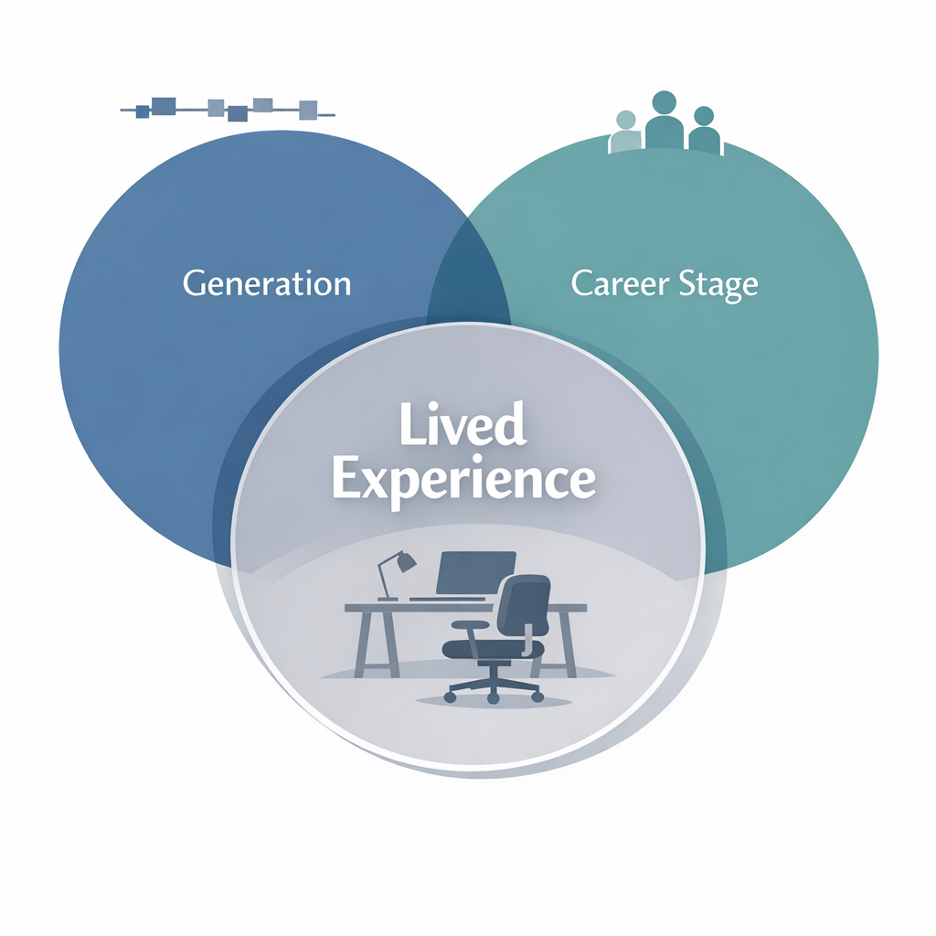
The session pointed out that, currently, there are five generational cohorts in the workforce. Now I am personally skeptical about generational categorization. I think length of experience in the workforce is a more determinative factor than year of birth. But the two things do largely correlate, so maybe that’s just semantics. My only caveat is that while any system of categorization can provide context, all are prone to over generalization. None provide an adequate and reliable solution that can be rigidly and uniformly applied to the leadership dilemma. 

So, regardless of how you categorize in order to try and understand them, there are many varieties of life experience in your workforce today. Each brings different needs, expectations and preferences to their role.

One thing is common to ALL of them: they are all coexisting in a workforce struggling to adapt to massive, recent disruptions that haven’t been fully resolved in an environment that continues to face new disruptions at a rapid and unrelenting pace. Things aren’t going to settle down and provide us more certainty any time soon.

There are the obvious external disruptions, from technology (including but not limited to AI), to changing market conditions and business imperatives, and combustible societal and political factors.

But many associations are all still coping with even the basics: an incomplete adaption to a post-COVID workplace and lack of comprehensive agreement on how we are meant to work today. And just as with generational categorization, here we are equally prone to oversimplify: is the “right” approach work from home, return to the office, or hybrid? And while hybrid seems to be the golden mean, exactly what hybrid form, structure, and processes are meant to apply eludes any clear and universally applicable judgment. Flexibility is desirable, but how flexible can we be, and meet both individual and organizational needs? There is no one right way, and many associations are still struggling to find theirs.

So we’re trying to get things right in unsettling and uncertain times. That is not a condition that is conducive to getting the best from people. 

To be sure, what we see in the workplace today is just the latest phase in a decades-long evolution from hierarchical, rigid structures of direct authority to more flat, collaborative hierarchies. In that sense, none of this is new.

But we are experiencing it in a particularly acute moment of disruption and uncertainty.

It is all happening so fast and on a massive scale.

The seminar left me with two, overarching take-aways;

  1. This isn’t going to be solved in a one-and-done manner. We all hunger for a fix that will last at least as long as the models they replace. But it won’t be that simple. It is a truism only because it is true: our only constant is change. We need to be adaptive today, tomorrow and consistently into the future. And the future is coming at us faster than ever.
  2. Senior management needs to be humble and self-aware. Staff is looking to us for a degree of clarity and certainty that, frankly, we cannot provide for them. While, with maturity, we may have a higher tolerance for ambiguity, senior management is also struggling to find the right norms of operation as a team themselves. And we are people too, just as vulnerable to doubts and uncertainty as people are in the structures lower down in the overly simplified concreteness intended to be conveyed in an organizational chart. 

But as leaders something more is called for from us. What we are called to do is approach these conditions with a reality-based, but constructive and positive attitude. Not naïve sophistry, but not defeatism either. Acknowledge rather than downplay or dismiss the validity of what people are feeling. But also act in firm assurance that, while we don’t have absolute answers to all their concerns now, this is solvable. 

That solution won’t come as edicts from on high; they will have to be crafted collectively. Something is called for from every member of staff, not just the c-suite. But the promise of reward is there.

Oh, and then there is the dynamic of effective leadership as a staff and the contiguous dynamic of effective leadership from voluntary governance.

It should be fun. It is certainly a challenge. 

While generative AI has been used to create the accompanying graphic, I do not use AI tools in composing the content.

Dark Days Shine New Light on Profession and Community

The National Society of Professional Engineers vision is “a world where the public can be confident that the engineering decisions affecting their lives are made by qualified and ethically accountable professionals. Professional Engineers (PEs) are involved in everything. They may not be the people the public sees on the front line, but they are always there, supporting and contributing to the quality of life of every person, every day, in important ways. Often, however, these contributions can only be fully appreciated after the fact.

At the time this is being written, we are in the midst of a global pandemic. By the time you read this, things will hopefully look much brighter and more hopeful.

Nonetheless, right now is a true test of the professional engineer’s commitment to health, safety, and welfare. PEs are uniquely qualified to address many of the problems faced by society in the wake of the coronavirus breakout. This is especially true as we move forward to a time of rebuilding to recover from the crisis. (And we will recover.) More importantly, it is true as professional engineers work to prevent something like this from ever happening again. It is important, now more than ever before, that we band together and use all the resources provided to us through our community.

This crisis has forced PEs to learn to carry on in new ways, when the traditional work environment has been taken away. And the professional engineering community has responded heroically. Every day they are continuing to do what they can, overcoming challenges and disruptions—and what they can do is proving to be a lot.

On the most basic, operational level, the staff and volunteers of the National Society of Professional Engineers (NSPE) are now routinely using technology and communications tools that have probably been on our devices for years, but we never used before. We’re learning how to use them effectively.

What we have learned about being more effective and productive under duress are skills we need to preserve and carry forward once life returns to normal, even as we reintroduce the vital element of direct human interaction.

NSPE itself is not immune from the impacts that have rocked the general economy and commerce in our country. Virtually overnight, streams of revenue have slowed or been cut off entirely; invested financial reserves have dropped precipitately in value; and there is no way to predict how long these conditions will prevail, or whether the worst might be yet to come. This event is bigger than NSPE: Each and every one of you is facing equally existential challenges to your families, your employers, your homes, your neighborhoods, your livelihoods.

But the organization has responded quickly, made difficult and often painful decisions, and implemented aggressive cost-saving measures across the board to ensure sustainability of operations in the face of these challenges. Those necessary steps are usually measured in dollars, but there is a human cost as well. We have made reductions in staff both in areas where the volume of activity is down and in areas where some level of value creation and delivery can be sustained, but at a reduced level. Remaining staff has made sacrifices, too, accepting reductions in salary, even as they are called upon to do more to make up for their colleagues who are no longer here.

But we remain focused on what this is all for: The mission of NSPE is too important to put on hold for a virus. Even as we all deal with difficult and disruptive times, NSPE leadership, volunteers, and staff are resolute and firmly committed to doing the very best we can to be there for our members and customers, delivering relevant and important benefits in this time of need.

All of it—the painful cuts as well as the adaptation to keep vital services flowing and to create new ways to support our members—are aimed at sustaining operations in the short-term, continuing to deliver maximum value wherever we can, and staying strong in order to seize the opportunities for rapid and vigorous recovery when this crisis is passed.

But at times like this, we are reminded that the national society alone isn’t enough; a state society alone isn’t enough. You need that entire network that includes all these elements. I have come to understand with new immediacy how right the NSPE strategic plan was to ground itself upon the concept of a single, integrated membership, supported by seamless services provided through state and national societies and local chapters in concert and collaboration—even when external circumstances make that unbelievably difficult.

But “network” is really just another word for community. Community is just an abstract word for a group of individuals. Interdependent and interconnected. Where benefit created anywhere benefits everyone, and harm suffered by anyone, anywhere, diminishes each of us.

Or, as John Donne put it nearly four centuries ago: “No man is an island entire of itself; every man is a piece of the continent, a part of the main; if a clod be washed away by the sea, [the whole] is the less.”

True North

The following is adapted from remarks delivered at the National Society of Professional Engineer’s House of Delegates General Assembly, July 22, 2017 in Atlanta, Georgia.

round_compass_logo_400x400As NSPE ends one fiscal/program year and starts a new one, it would be typical to talk about the past year’s activity. That is worth doing:  we have a good story to tell, and NSPE’s accomplishments of 2016-17 are something we can all take pride in.  But that would be repeating a story that you have already been told, as it was happening.

Besides, it has all been neatly summarized the NSPE Year in Review: 2016-17, which is available online at:

www.nspe.org/review16-17

So I thought I would focus my remarks at a higher level.

Culture is defined by values: foundational, unchanging principles that define what we believe and that determine the choices we make in the face of an ever-changing day-to-day reality. It is our compass, if you will.

The actual course we chart may need to change in the face of external realities beyond our control, just as a storm may require a ship to take a different route than the one originally planned. Technological advancement allows us to abandon sailing ships as our mode of forward progress when better means (such as steam ships, airplanes, rocket ships) become available.

But true north remains a constant.

Culture trumps politics, rules, legislation, structure, even strategy. No amount of tinkering with a law, procedure, or regulation is sufficient if a culture has been abandoned, forgotten, or has become unhealthy. Progress and improvement are possible and absolutely necessary, but only if grounded in a culture that remains relevant and is informed by our shared, timeless and unchanging values.

NSPE’s founders understood this.

It has become a commonplace to observe that NSPE was originally founded to unite a community in order to establish PE licensure laws in all 50 of the United States and its territories. But this mistakes means for an end.  Licensure is merely the outward form that makes our core values and beliefs tangible in our world.

Those values are summed up nicely in NSPE’s Statement of Principles: Being a licensed professional engineer means more than just holding a certificate and possessing technical competence; it is a commitment to hold the public health, safety, and welfare above all other considerations.

That is not to say that we don’t need to continue to exert activist and diligent effort to define, promote and protect licensure rules and regulations. With the very concept of licensure under increased attack, those rules and procedures, tactics and strategies, legislation and regulation demand our vigilance and constant effort.

But I think it is instructive and useful from time to time to take our eyes off the licensure tree and remind ourselves of the forest we seek to nurture, grow and preserve: the professional community that is NSPE.

The new membership business model overwhelmingly approved by the NSPE House of Delegates at its General Assembly in Atlanta in July is another one of those means that should never be mistaken for an end. But the means are important.  Decisions on policy, strategy, and yes, even on the mundane details of the organization’s administrative and financial structure, have consequences.

For NSPE’s elected leadership, at the national and state levels, crafting this new approach to doing business required balancing the needs of a diverse membership and each member society in a manner that best serves the community as a whole.  All the internal operational matters that national and state leaders worked so hard to resolve were the necessary, if sometimes tedious obligation of leadership, but an administrative effort tied to a higher purpose and intention.

The new membership business model is a new vehicle, intended to re-energize, re-invigorate and restore a culture and ensure its viability and efficacy in a world that has changed much since the Society was established in 1934. But it is a vehicle that remains aligned to true north. It remains directed toward the same timeless truths that motivated the founders: that NSPE exists:

  • To protect engineers (and the public) from unqualified practitioners,
  • To build public recognition for the profession, and
  • To stand against unethical practices.

It recognizes that although the technical problems of each engineering specialty are divergent, the professional problems faced by engineers are alike. And that, while the technical societies, for the best fulfillment of their essential purpose, are divided on lines of differentiation, this division into separate organizations prevents effective united effort for the interests of the profession as a whole. Those aren’t my thoughts, or the current board’s. They are the principles articulated by NSPE’s founder, David Steinman, in 1934.

He went on to conclude that a “single national professional society, with solidarity of purpose and concentration of strength, is needed to provide effectively for the professional interests of the engineering profession” and that, to be successful, “unity and geographical organization are the essentials. The national society, the state societies, and the county chapters are closely and reciprocally integrated, and all are regarded of equal importance, with membership in one meaning membership in all.”

The new membership business model marks an evolution that revitalizes NSPE as a system of partners that are neither national-centric nor state-centric, but PE-centric.

The new membership model is not perfect – no product of fallible humans could be.  But it is the product of a serious and careful effort over the past year and a half to make the best decisions possible. And to the army of state leaders (staff and volunteer) for the hundreds of hours they have invested in designing the model, my sincere thank you.

And to all licensed professional engineers, whether members of NSPE or not, we’re just getting started. We’ve re-tooled our craft. We remain resolutely aimed at true north.  And we intend to blow you away with what we accomplish next.

CEO effectiveness & volunteer boards

I was recently invited to share one piece of advice from what I have learned in my years as an association chief staff officer on effective partnership with volunteer leaders, for a book soon to be published by ASAE.  After giving  some thought to the matter, for me it came down to what JimiStock_puzzel Collins calls Level 5 leadership: “the paradoxical blend of personal humility and [fierce] professional will.” You need to be able to take your own ego-gratification out of the equation when assessing the association’s strategic needs, but also refuse to make allowances for any limitations that might be present on your board by compromising on the level of leadership their role demands from them. You need to be authentic in giving the board credit for association success and in truly owning any board failure as your own. And never, never, never, letting a setback cause you to doubt yourself or become tentative and risk averse. Take the hit, learn what you can from it, turn the page, and move on. In doing so, you become not only something of a safety net for the board, making it less risky for them to take bold action. You also model the behavior that will enable them to be effective in their own leadership roles.
Why change is hard and so often goes wrong

imagesA member shared this video with me recently, which demonstrates that knowledge does not equal understanding and that it is very difficult to change biases.

http://viewpure.com/MFzDaBzBlL0?ref=bkmk

Watch the whole 8 minutes if you can … there is more here than the initial “hook” of the video: how changing one thing makes even a simple, customary task more difficult.

The video triggered (unpleasant) memories for me of every strategic planning initiative I have ever been involved in, as a staff leader, a volunteer or a consultant.  It makes understandable how quickly and easily a new paradigm, once mastered, can be abandoned … particularly by those who have lived longest in the old paradigm and who are generally the ones in positions with the most organizational influence.

It is very relevant to where my own organization, is right now.  We did things right: engaging members (not just active volunteers) in collecting data on their needs, expectations and aspirations.  We listened with open minds, willfully rejected pre-conceptions, and applied what we learned in an open-minded fashion. We took the time to build broad consensus on future direction and focus long before we tried to reduce it all to words in a strategic plan. We have the knowledge, and understanding, and even buy-in to that new vision and its goals, clearly articulated in a new strategic plan, and being applied with discipline to our actions, programs, and branding messages. But agreement, will, and intention are not enough to keep the new bicycle on course.  And this little video demonstrates why, so often, the final result of even big change often ends up looking a whole lot like what it was supposed to replace.

So take this as a cautionary tale.

Context, continuity, and generations

long view 2A lot of self-help books and personal development coaches advise taking a break from your area of professional focus every now and then to read things entirely outside your field.  In today’s world of mass media, information overload, and 24-hour-a-day, day jobs, that is increasingly hard to do.  But I have found this to be a valuable piece of advice throughout my career, as was brought home by two separate instances in the past week, neither of which had any connection to the field I represent at my association.

First it was my privilege to be included in a small dinner, hosted by Mark French of Leading Authorities, to hear John Pistole, the former deputy director of the FBI and, until this January, head of the TSA.  He offered up a piece of advice from his long career in intelligence and law enforcement that struck me as equally applicable to associations and other mission-driven organizations:  Text without context is merely pretext.  A piece of data, no matter how intrinsically significant, can be manipulated or inferred to support any conclusion you want it to, until you place it meaningful context.

Twitter feeds remind me of this every day: highly distilled nuggets of what looks like wisdom that only rise above being empty, if clever slogans if I happen to be in-the-know with the community, situation or events that provide a context for understanding it.

Later in the same week, I was reading a literary and theological journal devoted to the thought of writer/philosopher G. K. Chesterton.  One excellent article1 caught my particular attention. Its author, David Fagerberg, a university professor, observed that it was his impression that generational variations (in attitudes, preferences, styles of behavior and communication) occur much faster than do the changes in sociological cohorts (millennials, baby boomers, et. al.), which are measured in decades.  Generational changes manifest themselves closer to every four years than every 40.

He went on to observe that with each new generation, our communities experience a form of amnesia, similar to the short-term memory loss suffered by the protagonist in the film Momento2. We like to talk about changes our organizations are making in society, but every day, a new generation is becoming a part of it, without any memory of the history behind any group, cause, fashion or fad they encounter.

To them, everything is new.  But, in one sense, there is nothing new under the sun. As Fargerberg pointed out and Chesterton wrote nearly a 100 years ago, today’s revolution, is really just a reaction or counter revolution to yesterday’s new perspective, which was in turn a reaction to the day before. Wait long enough, and you see rebellions repeating themselves and matters of fundamental truth, justice, ethics, whatever you want to call it, ultimately prevailing (albeit, often clothed in newer, contemporary costume).

That is why storytelling — creating a context — is so important for any mission-driven enterprise.

Core mission, our purpose and reason for being, if it is authentic, remains unchanged and unchanging. Reminding people of history, of what got us here, is so important to triggering a recognition of why what we are doing today is important and relevant. But understanding how to communicate that core mission in terms that are relevant to today’s frames of reference requires dexterity. Today’s frame of reference will be different tomorrow.

Taking the long view, fads come and fads go.  “[T]he great danger of the moment,” Chesterton wrote, “is that young men will become content with these revolts against revolt, these reactions against reaction; so that we have nothing but an everlasting seesaw of the Old Young and the New Young; the last always content with its fleeting triumph over the last but one. And the only way to avoid that result is to teach men to stretch their minds and inhabit a larger period of time.”  Over time, if the mission remains valid, history will show how it “has one by one outdistanced all the runners who prided themselves on their youth and advanced positions … By that time, it will be more apparent than ever that these jerks of novelty do not create either progress or an equilibrium3.”

That is not an invitation to complacency.  Waiting for each new generation to gain the perspective of the long view is fatal. We might eventually be recognized as having been right, but only posthumously.

Another all too understandable trap is equally fatal.  When enlivening the old mission with new energy seems impossible, it is tempting to focus on form over substance, trying to impose past structures, hierarchies, and processes, in an authoritarian, fundamentalist fashion, as if going through the motions all over again will recreate the sense of purpose that originally sparked them.

Becoming prisoners of our history is another danger: the feeling that we can not make progress today without first going back in time (as if that were possible) to correct the problems and mistakes we made then.

So I hope I am not coming across as a worshiper of a dead past or a cheerleader for the status quo.  Far from it.  Change or die?  True enough.

But as Chesterton reminded me, not all change constitutes progress.  Equilibrium is necessary for progress: the clarity and stability to not become distracted from the core, unchanging thing and seeing how best to serve it in the world today.  Otherwise we will constantly be dashing off in new directions and losing the line.

The challenge lies in simultaneously: 

  • Acting in the present, in a manner that is immediate and responsive to today’s passing perspectives; and
  • Staying connected to the roots and in continuity with the history that got us here, inviting those for whom everything is new to see their place in it.

In short, providing context.


1 “On Generations,” David W. Fagerberg, Gilbert Magazine, Volume 18, No. 2-3, November-December 2014.

2 And how many of us, even with birth dates separated by only a few years, actually remember Momento?

3 The Well and the Shallows, G. K. Chesterton, 1935.

The Future of Membership?

future of membershipOn November 6th, I was invited to present a TED-style talk on the “Future of Membership” at the first Association Chief Executives (ACE) Symposium.  My thesis:  volunteerism not membership is what makes our organizations unique; membership is a means to an end; the metrics we use to judge membership success are all wrong; and the bottom line: get clarity around your mission (your purpose) first, then worry about what form of membership (if any) serves that purpose best.

Read the presentation here.

What the world needs is more association executives

Closing the ASAE annual meeting in Dallas, author Dan Pink argued that, regardless of profession, we are all in sales. But the characteristics, skills and traits he described as essential for success sounded to my ears like precisely the attributes that distinguish effective association leaders, and differentiate us as a profession.

Read more in my latest commentary in Association Trends: What the world needs is more association executives | Association TRENDS