Generations or Career Stage or Brave New World?

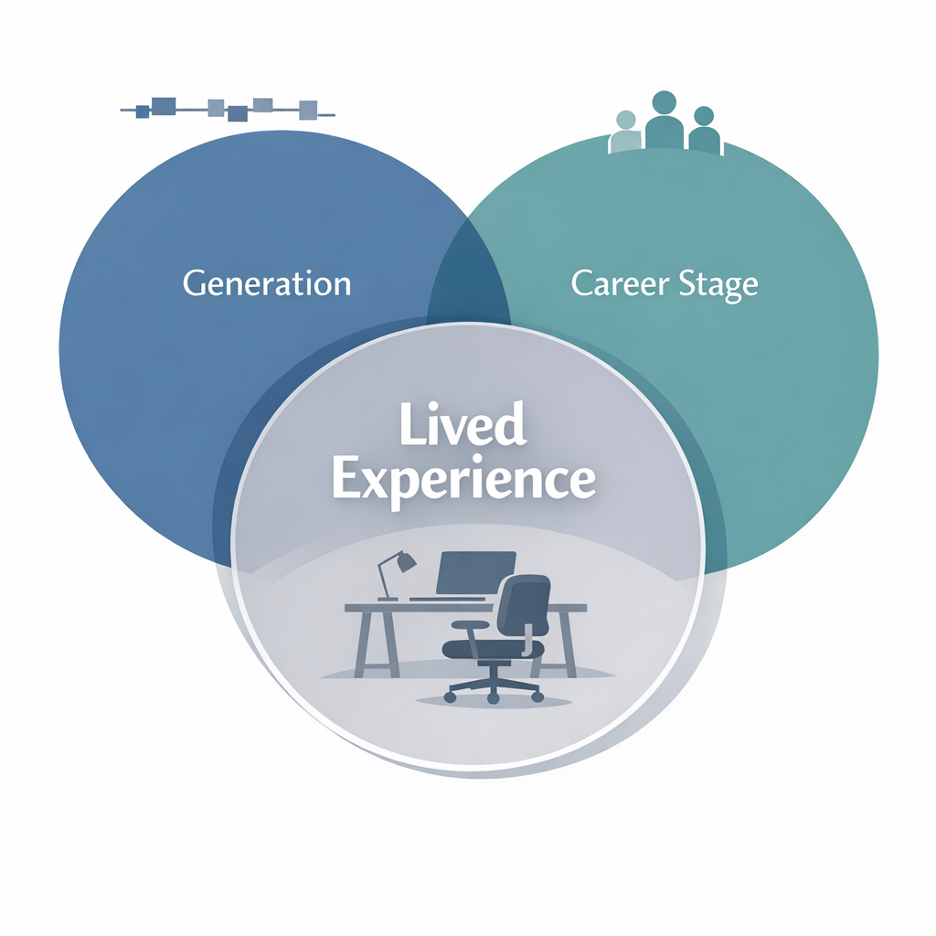
I have always been skeptical of the literature generalizing generational differences. They tend to define changes in behaviors, preferences, and attitudes based on year of birth as if these were hardwired, evolutionary changes in DNA that emerged in the species at fixed points in time. It always seemed to me that career stage (regardless of year of birth) was a far more meaningful factor in trying to understand where individuals were coming from. But I have reached the conclusion that neither are sufficient frames of reference for understanding the workforce.

I have come to appreciate the more significant impact that macro-level disrupting changes can have on all generations and levels in the workforce. How are they impacted and how do they respond to it? In short, the current lived experience is more impactful than either year of birth or career stage.

It’s about more than just technology and tools

You’ve all seen the online clickbait: “If you recognize what these pictured items are, you were definitely born before X date.” Rotary telephones, floppy disks, physical Rolodexes, etc. 

But it isn’t only technology and tools that date you. At any age, you can always learn new tools. There are historic changes that affect the entire workforce even more profoundly. Epoch defining events, like world wars, economic depressions, 9/11, and the pandemic-shutdown permanently changed the world and required each of us living in it (regardless of generation) to reassess the nature of our relationship to that new world in every aspect of our lives. The workplace isn’t immune.

What constitutes normal?

It is only human nature: what we are accustomed to feels normal. Any macro event that fundamentally changes the nature of things is going to cause those used to the way things were before to feel like the new reality is abnormal. The longer the period you were able to work, grow and advance in the pre-disruption environment, the more abnormal the new world feels. 

For those who never experienced what normal used to be for the role they currently find themselves in, the new normal feels like a given, even if it is a given that they are still actively struggling to grasp and understand. But it’s all new to them; they don’t have as many established habits to unlearn.

For those with work experience in their current roles both pre- and post-disruptive change, the period of uncertainty over what the rules of the road are or ought to be is equally unsettling, regardless of their generation. 

The simple march of time means an increasing proportion of the working population are now digital natives. They never lived, let alone worked in a world without computers. Those who had to live through and adapt to the emergence of a digital world are increasingly, if not already a small minority. It’s probably well past time when those in this category need to just get over it. There are more pressing issues to deal with.

The post-pandemic reality

The same can’t be said for the adjustment to a post-pandemic new world. It’s still too new and too unsettled.

A small but increasing portion of the population in the workforce never worked under pre-pandemic shutdown conditions. While more seasoned workers are struggling to adopt to a “new normal,” these individuals are totally unfamiliar with the “normal” their more tenured colleagues experienced and are trying to cope with losing.

Even those who entered the workforce shortly before the pandemic lockdown have had less experience acclimating themselves to the old normal than their more seasoned co-workers. They are less hardwired into the old normal, but I don’t know if that makes resolving what the new normal ought to be easier or harder to imagine and adjust oneself to.

Maximizing flexibility is the thing we all seem to have agreed on

During a recent CEO dialogue, the usual shorthand for this topic emerged. We tend to lump this into the debate over in-person, all-virtual, or hybrid workforces. But it is more nuanced than where workers are sitting.

At least in the association space, I don’t think the 100% in-office party has built any kind of constituency.

The pro-all virtual party argues: “We worked successfully in a 100% remote work environment during the lockdown. Why does it need to change?” Assumptions about organization size correlating to success as all-virtual organizations don’t appear to hold, so judging what is most appropriate by organization size isn’t much help.

The pro-hybrid party argues that there has been a loss of social cohesion in the all-virtual environment that is costing the organization in ways that those who never experienced the pre-pandemic normal can’t fully appreciate. 

No employee mourns the opportunity to jettison the cost (in time and money) of a daily commute. No CFO is upset over the opportunity to jettison high office space occupancy costs. But that doesn’t mean people aren’t frustrated when they can’t interact spontaneously and easily with others … that it’s always necessary to schedule a meet up. This is particularly true if they have lived the experience of the kind of serendipity that occurred in a staff working in close physical proximity that was taken for granted in the pre-pandemic world. (You don’t know what you’ve got ‘til it’s gone, as Joni Mitchell sang. And there … I just dated myself in a way younger gens won’t get.).

One thing is clear: whether hybrid or all-virtual, flexibility is clearly the governing value we all seem to be seeking to maximize. It enables a happier and more productive workforce.

It takes more than policy statements

But uncertainty remains the dominant state. Where does flexibility end and organizational synergy begin? Violating norms that aren’t clear to you is a source of fear, anxiety and conflicts. What is expected and what is it reasonable to expect in the desired state of maximum flexibility?  It manifests itself in several specific ways. 

  • When is it appropriate to send an email outside of (previously) normal working hours, with the implicit expectation of response[1]?
  • If my exercise of flexibility in hours worked is different than yours, what happens if our interaction is necessary? 
  • Is a phone call ever better than asynchronous communications and what are the norms for this?

And I could go on.

Simply writing that everyone is expected to be “available” during set, core hours into your employee manual is reasonable, but insufficient.

Similarly, mandated days in-office makes logical sense, but only if the nature of the work that occurs makes being in the office worthwhile. (And I see absolutely no logic to policies that require X days per week in the office – choose whichever days suit you. As if just being in a physical place makes magical things happen for you.) 

The deeper into things you get, the more questions emerge. Second wave questions that have already emerged include such things as:

  • If distant remote employees are expected to travel to HQ for mandatory all-staff events (typically between two to four times per year), who is responsible for their extraordinary travel and housing costs? 
  • How do workers, eager to succeed for themselves and for the organization, get the direction and support needed to be successful, beyond project plans, deadlines and tasks?
  • How do (in particular) early career stage individuals build their professional networks and gain awareness of functions outside their assigned areas?

And there are trivial but amusing examples of the disconnect as well. 

Like the number of employees who, in an environment of 100% remote work, asked if they would get the day off the first time a snowstorm hit. 

And one colleague who got a lot of feedback that staff wanted the performance management system to be less burdensome … in a situation where employees were only asked two open-ended questions, three times per year[2].

But it goes to the issue we should have been addressing all along: how effective is our system of feedback and direction, regardless of the time required to engage in the process? And how consequential our in-office experiences actually are.

One thing seems universal: employees don’t want to follow procedures that seem to them like a waste of time. They never did. But in today’s environment, policies and procedures that don’t make the actual work experience rewarding and productive are even more toxic to the enterprise. And the evidence I have observed seems to indicate many organizations haven’t fully answered that question yet.

Where we go from here

At least four trends (or imperatives) appear to be in play:

  • Clarity and shared understanding of expectations is needed in a system designed for flexibility with boundaries, communicated in a transparent and purposeful manner, not as arbitrary edicts or vague statements of the ideal, left open to interpretation.
  • Better execution of virtual collaboration systems than many (most?) associations have yet to implement, even if they have the technical capacity to do so.
  • Shifting to a more “results only” oversight and performance management approach, rather than time or task measurements.
  • Providing coaching and development support in a separate but complementary manner.

I am encouraged by the evidence I have seen of associations that are meaningfully redesigning both the physical, in-office environment (nod to you, ASAE) and the way they organize work (both in-person or virtually). But too many associations seem to be applying Band-Aids to their pre-pandemic conditions, merely tweaking the old normal, rather than inventing the new. As a profession, we have a long way to go.

Postscript: My reference to a “brave new world” is a bit of a Rorschach test. Did it prompt dystopian dread, as in Aldous Huxley’s 1932 novel of that name? Or the utopian optimism of the Shakespeare play Huxley took the phrase from (The Tempest)? I wonder if a generational generality might be inferred from that distinction.

Disclaimer

The ideas contained here are my own. I do not speak for any organization or company.

AI was  used to generate the image accompanying this post. I do NOT use AI to research, generate or edit drafts. 


[1] I know the arguments both for and against “no emails after hours or on weekends.” The actual answer is, it depends.

[2] As someone who for years endured the hours long process of a Paylocity-style goal setting and performance management system, this one made me smile.

The Staff > CEO > Board Relationship: A Matter of Perspective

Last week I wrote about the association CEO’s unique position in governance, situated as it is between professional staff and voluntary directors/leaders. That focused on the CEO’s role in advancing a culture of stewardship at both the staff and voluntary levels. I received numerous comments from CEO colleagues who agreed with everything I said but raised a slightly different and potentially more problematic set of circumstances surrounding board/staff roles. (And I heard more than one horror story about where, in their experience, things went bad, in one case to the point of nearly costing the CEO her job.)

The basic principle is straightforward: the CEO is responsible to the board; all other staff are responsible to the CEO. Staff performance is itself a part of the accountability that the CEO has to the board. 

Most often, all staff hiring, firing, promotion, and compensation decisions are explicitly and specifically delegated exclusively to the CEO in his/her contract. And frankly, in my own experience, I have been pretty impressed by how seriously boards have shown respect for that separation of authority. They understand why it’s so important: the board can’t hold the CEO accountable for staff performance if the board is meddling in the CEO’s autonomy to exercise the authority necessary to building and maintaining a high-performing staff. 

Pretty straight forward in principle. But as my peers’ reactions to that column demonstrated, not always so clear in practice.

The Board’s Limited Perspective of Staff

Where the challenge can arise is a matter of the board’s limited perspective of staff.  Some staff positions are more member-facing than others. These are the staff members that voluntary leaders see and interact with directly. They have direct evidence of how well or how poorly such staff are performing those portions of their responsibilities that are visible to them. The problem is, they are forming a judgement based on only a limited perspective of that staff member. And they only see the pieces that touch them

Who Goes Unnoticed?

It’s why I always get so uncomfortable when the board wants to publicly recognize a member of staff for a job well done, even when such recognition is richly deserved. Now, I am all for recognizing and celebrating individual staff everywhere and in every way that it can be done. But when the board or a committee wants to single out the director of meetings for a successful conference, or the director of credentialling for the successful launch of a new certification, or the director of government relations for a legislative win, this can potentially set off negative ramifications elsewhere in staff. 

The board isn’t wrong in perceiving and wanting to acknowledge the performance of a staff member they work with directly. But they can only recognize the performance of the staff members they actually see. Who else goes unnoticed?  There are always others, in less directly member-facing roles who may have contributed as much or more to the accomplishment being recognized. 

There are also staff members whose roles are no less critical to the organization but are largely invisible to voluntary leaders. The only way they will ever come to the board’s attention is if something goes horribly wrong. 

When any staff member who had a material role in the success the board is celebrating are left out of recognition, and whenever a staff member or department feels unrecognized, they feel demotivated, unappreciated, and marginalized.

What Aspects of Even the Staff Members They See Are Hidden from Them?

And my colleagues pointed out an even worse case but not entirely uncommon scenario. There is a staff member the board or committee works with closely and continuously over a long period of time. That staff member is exceptional in the level and quality of support they provide the board or committee. Personal relationships are built. 

But they are seeing only the piece of an iceberg that is above the water. 

What if there are other, legitimate performance, skill, or behavioral issues going on underneath? 

Generally, these issues are minor and manageable. They might be uncomfortable and difficult for the CEO but buckle up. They can and need to be addressed. Most often, with a competent CEO, they are.

An Admittedly Extreme Example

But one particularly egregious case shared with me concerned a staff liaison who was truly extraordinary in meeting the member-facing aspects of his job. An absolute super star. But hidden from the voluntary component he supported were deeply problematic performance issues vis-à-vis this individual’s interactions with other staff. Persistent patterns of behavior that were contrary (and corrosive) to staff values and culture. And at so serious a level that other staff found ways to work around him rather than try to deal with him directly. He was that toxic an employee. 

As the CEO who shared this story put it to me, she had gone to great lengths to coach and develop the employee, providing training and support and encouragement that would allow him to correct his deficiencies and be truly successful at all levels of his job. She admitted that she went above and beyond the lengths she would have gone to with a staff member in a less member-facing role. Still, the employee’s behavior truly rose to a level where dismissal was warranted. But, my CEO colleague added, “how could I fire an employee so universally beloved by every member of leadership he ever supported?” 

Of course, one extreme case does not generalize to the commonplace. But it underlines the critical necessity for the CEO to cultivate a level of awareness, appreciation, and understanding by the board and other voluntary leadership that every staff member is an iceberg and they only see the piece above the water.

Building a Foundation of Trust

This is a matter of appreciating not just the principle at work but earning a solid relationship of trust by the board in the CEO’s judgement sufficient to weather the hopefully rare occasions when such a degree of trust is needed. Despite the cognitive dissonance between what the voluntary leader sees in the employee and the actions the CEO takes, do they have enough confidence in the CEO to accept on faith that he or she knows what they are doing, and that it is truly in the best interests of the organization?

As a CEO, by the time you are in the difficult situation, it is too late. Trust needs to be earned and banked before you need to rely upon it.

Disclaimer

The ideas contained here are my own. I do not speak for any organization or company.

AI was used to generate the image accompanying this post. I do NOT use AI to research, generate or edit drafts. 

What does “going global” really mean?

It’s a question that frequently arises in conversations among my association peers. Every one of my associations has been U.S.-based but, to some degree, operated globally.[1]. And what I have learned is, like with so many questions of this kind, the answer always must start with “it depends …”

For a U.S. based association, aspiring to expand globally, I can identify at least four domains of possible activity:

Market and Revenue Enhancement

This is probably where most associations start when they are thinking about going global. What are the products or services (existing, repurposed, or new) that could be delivered outside the U.S. to generate revenue? Major caveat: there always needs to be mission consistency. Approaching international markets purely as potential ATMs for extracting revenue is not only naïve, but almost never successful. And, in my view, it is never legitimate. There needs to be a return on investment to the mission for every association offering. If it also happens to be financially lucrative, so much the better.

In some areas of the world, and depending on the scale of the program, this might require setting up overseas operations just to get in country. But not always.

Even if you are not setting up a satellite office, to be truly effective, operations in the U.S. for delivery overseas of even a single product offering requires more than just a cooperative local member in the target country. An individual member who can provide a facility to host your international event may not have the juice to attract local attendees, sponsors, and exhibitors, or the savvy to accommodate local regulatory requirements, or an understanding of what’s involved in a project of this sort. You need strong and accountable local partners, competent in the business and operational skills you aren’t present to provide directly. (And don’t get overconfident in your own ability to effectively provide marketing, sales and onsite management of operational support half way around the world.) It takes discipline to hold yourself to that requirement.

Diplomatic

Your association may be eligible for membership as the U.S. representative in an international federation. This one is tricky. In many cases the U.S. association is larger in terms of finances, scope of operations, content expertise, and staff than any other member of the federation, or even the combined resources of the federation as a whole. The federation (and its national or regional members) might value the relationship as an avenue of access to information and resources unavailable without you. But exercising your presence with too heavy a hand can cause more damage than good. (The global federation will always harbor the fear that you are after usurping their title as THE international representative of the field.)

On the other hand, if handled with diplomacy and tact, it is often very easy for your association to gain an impactful role within the federation in ways that advance your own parochial interests. Simply being more competent and experienced in association management can translate into appreciated and influential involvement.

Maintaining an actual presence and engagement in international federations is costly, both financially and in the time and attention managing the relationship consumes. Boards are often insensitive to just how much staff time and effort is consumed in ensuring that the President always gets invited to the international meeting and that we respond to every request for a “strategic alliance.” 

But when budgets are tight, the question of “what are we actually getting out of this?” comes up. And the answer is often soft (and suspect): showing leadership, adding prestige. It usually comes down to FOMO.

But sometimes this is something you still need to do; 

  • As a show of solidarity with the profession/industry, 
  • To stay in the loop on what’s going on beyond U.S. borders, and 
  • To enhance your brand. 

Being able to document specific accomplishments linked to participation is necessary.

Beyond any formal international federation, there may be opportunities for bilateral relationships with similar, usually national organizations outside the U.S. My one caveat here is: if you are going to do this, make the relationship specific, appropriately scaled, and one in which both parties get concrete value and are held accountable to each other. 

Don’t fall into the MoU trap, where just having as many resolutions to frame and hang on the board room wall is your metric of success. The management time and attention necessary to maintain even this Potemkin Village of international presence can be significant.

Developmental

This is the one that personally excites me most: delivery of your association’s knowledge and expertise, directly and in service to less developed countries. I am particularly proud of one of my association’s program sending teams of members to meet with their counterparts in countries in the developing world, providing practical support in areas of professional practice and impact. We sent such missions to more than 20 countries over the course of the past decade and provided post-mission (albeit, virtual) follow up and support. This is all cost, no financial return. It is huge for the local community but can’t, by itself, move the needle globally. Yet, to the extent you can provide it, it is the truest form of global mission impact for your U.S.-based association.

Collaboration/Engagement Opportunities for your own Members and Constituents.

This one gets overlooked but can be significant. As noted above, maintaining engagement in international federations is costly. But always remember to factor in the value of the opportunities it creates for individual members to participate in activities, such as research, publication credits, speaking opportunities, committee service, etc. It may be easier for a member to get a speaking role at the federation’s comparatively smaller meeting than national’s mega-conference. (This is particularly important in fields where “publish or perish” is a career imperative.)  This is also a way to identify and develop younger or early career members for future roles in the U.S. association. 

The management challenge here is maintaining meaningful contact and coordination with the individuals thus engaged. They may be your association’s appointed representative on the federation’s XYZ Council, but that does neither you nor them any good if neither is aware of what the other has going on.

In most cases, going global involves some combination of the above. And just to keep things even more interesting, the categories sometimes bleed into each other and can sometimes come into conflict (usually, in competition for resources).

I would be interested in hearing others’ thoughts on the inventory of elements that can go into going global.

Disclaimer

The ideas contained here are my own. I do not speak for any organization or company.

AI was used to generate the image accompanying this post. I do NOT use AI to generate or edit drafts. 


[1] Ironically, the presence or absence of “international” in an association’s name is not always a useful indicator of its degree of global-ness. My first association was the only one with “international” in its name, and it had the least to show for its global aspirations. My three most recent CEO gigs were with organizations that had either “national” or “American” in their names, and these had more substantive and meaningful international presence. (And in one case, this led to changing the association name to remove “American.”)

Truth Under Fire

Associations (the good ones, at least) have always served society by providing a trusted and reliable source of information. That would seem to be the key role we have to play in our current environment of decentralized information, public distrust, and AI/social media-driven echo chambers that value divisiveness and conflict over reasoned dialogue. 

We (often rightfully) believe we have the hard, objective truth that the public and society so desperately needs. Why aren’t they listening? 

ASAE foresightworks, backed by rigorous methodology under the auspices of the ASAE Research Foundation, offers continuous strategic intelligence on drivers of change. Its latest release, “Truth Under Pressure,” offers useful clarity and actionable suggestions on this matter. To cite just one of its many insights: “As you convene members and constituents, you have an opportunity to advance open dialogue in pursuit of a common truth … Your [association’s] position as a credible convener could be compromised, however, when your events appear to be self-serving or pursue limited ideological agendas.” 

The same could be said about how associations collect, analyze, and communicate its truths, and, in particular, how we respond to misinformation when we see it. 

We are long past an environment where we can simply put out the data and trust the facts to speak for themselves. The truth demands effective advocacy.

Too often, however, no matter how pure our intentions and our intended tone, our advocacy is received as “You are wrong. Trust us. We know better than you do.” Even worse, too often, the message is communicated in overly aggressive language that communicates: “That’s misinformation and you’re an idiot for listening to it.”

That isn’t going to get us where we are trying to go.

I have recently been listening to a really impressive podcast, “Why Should I Trust You?” It regularly convenes prominent spokespeople for those promoting a “counter truth” around public health issues. It treats its guests and their points of view with respect. It doesn’t debate or attack their beliefs.  Instead, to quote the podcast’s website, “We hear from people who are wary about public statements, recommendations and studies coming from what they view as an elitist and conflict-riddled scientific establishment. And we hear from those in this establishment who fear the consequences of what they see as a dangerous trend towards anti-expertise.”

The podcast’s approach is subtle but strategic: they are not debates, fact-checking every point; rather, they move the group to a discussion of the outcome/concern we share in common: a public health system that better serves those who feel excluded or that they have been harmed by the current system. That allows a discussion that shifts from conspiracy theories that feed off justifiable fear and distrust due to their (negative) lived experience, to applying objective and sober statements of what is knowable that might actually address the source of their pain.

[My only caveat about the podcast. It rightfully refuses to reduce the dialogue to soundbites.  Just what is needed to get past trading slogans and memes. But, while thoroughly engaging, they are long. I fear there are people who are reachable but might not have the patience to listen.]

On a recent episode on autism, Holden Thorp, editor in chief of Science, observed: 

[Holden’s blog post on his participation in the podcast offers thoroughly reasoned arguments for the exact same point I am trying to make here.]

Let me clear, I am not advocating compromising our rigorous adherence to scientific truth but rather deploying it in a way that acknowledges the validity of the other side’s concerns. Not “me right; you wrong.” But “here’s something we know, specific and tailored to your specific concern, that might lead to the solution you are hoping for.” It isn’t about winning the war between my facts and your misinformation. It’s about applying what can be known, reliably, to fixing the thing that made you a no doubt well-intentioned but possibly counterproductive advocate in the first place.

The tweet-wars will no doubt continue. But if associations are to truly serve society, something more and something different is required.

Returning to ASAE foresightworks: 

While generative AI has been used to create the accompanying graphic, I do not use AI tools in composing the content.

Making innovation a habit

To be real, innovation needs to be a habit, not a standalone project. And habits are learned through constant practice – doing something consistently and constantly until it becomes an ingrained feature of everyday activity. Something that is constantly happening, almost without conscious effort or thought.

Part of that is systems and environment. Apple is often and rightly cited as a model innovative organization. A major element in their success as innovators is that every aspect of operations, from the design of work spaces to management and reward systems, is calibrated to create an environment and culture that maximizes the potential for innovation to occur.

But perhaps a bigger element is the established habit of trial and error: Try things, even if they don’t pan out. Constantly.  And learn from both what worked and what didn’t.

The first woman to make the top tier of Forbe’s gallery of the richest people on the planet list is Sara Blakely, the founder and CEO of Spanx.  In the inevitable round of interviews that followed being named to this list last month, she frequently related the following item from her personal history. As a child, the conversations around the family dinner table were a little different than most.  Her father didn’t ask “What did you learn in school today?” Instead he asked “What did you fail at this week?” It instilled in her, from an early age, that constant habit of trying new and different things.  Just to see what works.  And what didn’t.

Of course there is a balance that needs to be struck. As our associations strive to reinvent and re-engineer core products and services to keep them relevant and effective  in a rapidly changing world, we have to risk trying and failing. But we dare not risk a total and catastrophic failure when this year’s annual meeting or this month’s certification and testing dates come round. There are too many members whose personal and professional success, as the world is now,  today, are dependent upon those services.  The association’s long-term need to innovate, evolve and grow cannot come at their expense.

But establishing a culture of innovation begins by establishing a habit of trial.  And a tolerance for failure.

Associations don’t have long tails

For a while there, Chris Anderson’s book, The Long Tail: Why the Future of Business is Selling Less of More, seemed to dominate the association consulting/seminar/blogging space.  Now that its currency has dimmed a little, I have a confession to make.  I struggled for a long time trying to like this book1.  But in the end, I came to the conclusion that its relevance to associations is, well, short.

Not that Anderson’s thesis isn’t sound.  The “long tail” he describes has to do with a retail strategy executed with enormous success by Amazon and Netflix, among others.  The traditional retailing approach is to reserve your limited shelf space (whether in a brick and mortar store or a virtual space) for large quantities of whatever is currently hot.  Profitability is achieved by selling lots of copies of a relatively few, in-demand items.  By contrast, in a long tail strategy, you focus on stocking a few copies of a large variety of items.  Your inventory is shallow but wide, as opposed to deep but narrow.  It is a strategy based on having enough different things on hand that you will undoubtedly have something that will be of interest to whoever comes shopping, rather than successfully predicting the few things that lots of people will want to buy.

As the graphic indicates, you end up with the same volume of sales.  (The area in yellow is equal to the area in green.)  You aggregate a large number of small, specialty markets into a sustainable customer base.

Fair enough.  And as a consumer with tastes in music, literature and movies that are decidedly not in the bestseller/widely popular category (five hour long, expressionistic productions of German opera, anyone?), an appreciation of the value of niche markets works to my advantage.

But associations are the antithesis of the retail model that Anderson is focusing on.  They aren’t predicated on defining a product or service mix attractive enough to build a large enough customer base from the general population to achieve profitable economies of scale.  Associations start with a potential customer base already defined by narrow and more limited interests:  a specific trade, profession or cause.  The populations that we, as association professionals, are trying to make into an economically sustainable market for products and services are already a subset, and sometimes a very narrowly defined subset, of the general population to begin with.  Within that already narrow segment along the power curve, can we possibly hope to build a sustainable model predicated on offering whatever any member might want, even if no other member does?  We enter the game far to the right of that power curve (in the yellow area): how long a tail can we hope to build from there?

Anderson’s Long Tail was a healthy antidote to the reductive nature of mass market retail thinking, which is all about getting to the lowest common denominator.  Mass market retail isn’t about giving the customer what he or she wants – it’s about diluting the offering until it gives just enough of something that a large number of people will want it.  No one gets exactly what he or she was actually looking for; everyone gets just enough to make the sale.

And that is a lesson that associations would do well to take seriously.  We can’t build successful organizations with offerings that excite and delight no one but are mildly interesting to all.

But associations are not mass markets to begin with.  We exist to serve unique, niche markets.  And that raises the stakes on getting the product and service mix, the value proposition, exactly right.  We don’t have the luxury of a long tail.

1 I liked Anderson’s next book, Free, much better, and in fact did a presentation on it which can be found here: https://markjgolden.com/wp-content/uploads/2012/01/free.pdf.

Stay focused on mission

The new president of the national, not-for-profit organization urged his membership to remember: “The [organization] we passionately love is hardly some cumbersome, outmoded club of sticklers, with a medieval bureaucracy, silly … rules on fancy letterhead, one more movement rife with squabbles, opinions and disagreement.” No. All those elements might exist, or be perceived to exist within our boards, our membership structures and our collective actions. But your association — any association — exists for some other reason. Some higher purpose.

Do we allow ourselves to be distracted by process or diverted into passionate disputes over secondary matters? It is the fastest path toward driving off members and losing relevance.

Or do we stay focussed on mission, the shared aspirations that transcend structure, process and individual differences? When faced with the immediate, the urgent, do we keep that larger purpose in mind?

The speaker I quote is Archbishop Timothy Dolan, presiding at his first meeting as president of the U. S. Conference of Catholic Bishops. It would certainly be pretentious and foolish to elevate our professional or trade group to the status of a church or consider our association a religion. But the reminder to keep first things first is certainly relevant.

Stop competing

That somewhat startling and counterintuitive piece of advice comes from futurist Dan Burrus.  “No matter what your angle for competing – whether you are competing on price, service, quality, time, design, or anything else – the unfortunate outcome is you’re making yourself too much like everyone else.  So even when you are in the lead, someone else eventually matches you. 1

A lot of what he has to say resonates with the world of associations.  Yes, the days when everyone automatically joined their association because “that’s just what people in the profession do” are long gone.  Members are more demanding and insist on demonstrable and tangible returns on their investment before they will offer you not only their dollars, but their volunteer time and even their attention.  Associations are being driven to be more efficient and productive — to run more like a business.  After all, “not-for-profit is a tax status, not a business philosophy” and “no means, no mission!”

But in our quest to become more businesslike, or put another way, more competitive with for-profit vendors of services, information and product, are associations voluntarily sacrificing the very thing that makes them uniquely competitive in a world of expanding options for consumers?

Association journals, newsletters and magazines face competition from unaffiliated information and content providers (online and in print) who often have superior advertising or other financial resources to draw upon, enabling them to beat the association on price.  Association meetings and conventions face competition from unaffiliated education and networking opportunity vendors who have the luxury of focusing only on what’s hot and leaving the less glamorous, basic education to others.  And I could go on.

Let me be clear: being slow, out of date, locked into fixed and unchanging models, inefficient, irrelevant or costly are never excusable faults for an association. They are fatal. Associations can learn from our competitors how to be better and adopt their successful tactics in the market spaces we share.

But compete purely on their terms — as if you were just another periodical in the publications market space, or just another conference provider, or just another social networking venue — and chances are they will beat you.  They don’t carry all the baggage that an association does and will always be nimbler and more ruthless in jettisoning “unproductive” segments of their customer base.

A better way, according to Burrus, is to constantly find and promote new and different things you can do that defy any comparison to the alternatives. 

For associations, that means never losing sight of, and never failing to push and promote what it is that makes the association enterprise different from a department store or online retailer.  Some of the baggage associations carry, that same stuff that can sometimes make us less competitive than we otherwise would be in specific product or service lines, is the most unique, valuable and important thing we have to offer.  The thing that would be missed most if we disappeared.

As associations, we dare not delude ourselves with high sounding but empty rationalizations of our self-importance.  We need to be brutally spin-free in defining that unique value we offer that commercial vendors do not and in assessing our performance in delivering it to members.  But we also need to herald the difference, not jettison it.  We lose as competitors if associations allow themselves to become just another in the plethora of indistinguishable sources of information, meetings, education, etc.

1 Techno Trends, September 2010 (Volume XXVI, No. 9)

The Loyalty Factor

As consumers, there are some products, brands, or stores we frequent out of habit. And in stable, calm and good times that’s enough. Trouble is, all it takes is the slightest little disruption to make “because I have always shopped here” an insufficient excuse for me not to take my business elsewhere. Associations are even more likely to get complacent and assume that membership loyalty runs deep, when it may just be a fragile habit.

The current economic downturn is testing the limits of member/customer loyalty severely. As budgets get tighter and every penny spent gets heightened scrutiny, even the most engaged members are taking a hard look at the relationship. Not too long ago, I had the opportunity to spend some time with marketing expert Jim Kane, author of Virtually Loyal and The Loyalty Switch. He draws a distinction between customer satisfaction and customer loyalty. Satisfaction is a reaction to a client’s past experience with you. Customer loyalty is about future behavior.

Economic security depends on converting your satisfied customer/member into a loyal customer/member.  And that is all about establishing a relationship … something associations are ostensibly good at.  But do we actually deliver on that feature of our association brand promise?

Customer relationships can range from antagonistic to loyal. When you have an antagonistic client relationship, the client is basically forced to do business with you. From the provider’s side of the relationship, this can be quite satisfying. You’re guaranteed the business regardless, so you can operate in a manner that suits you.  (Associations offering mandatory licensing or certification programs or who have unique access to critical industry data or analysis take note.)   The danger, Kane points out, is that whatever factor is compelling the client to use you can change. Certification rules might be eliminated or a new research source might emerge.

One step above an antagonistic relationship is the purely transactional relationship. You offer a satisfactory service at a fair price that meets the member’s needs. An equal exchange. Neither side has any complaints, but no further sense of ongoing relationships exists.

Meet that standard consistently and it might grow to what Kane calls the predisposed relationship. The client is basically content. All things being equal, they will keep coming back. Most employment and client relationships, he contends, stop at this level. Its fine when times are stable and the economy is good. But that solid ground turns to quicksand the minute times get tough.

Which brings us to the highest level of the client/provider relationship: loyalty. Kane contends that these relationships are nearly unbreakable. They are based on more than price, quality or ability. Loyalty means there is an emotional bond: the member finds what you do indispensable, and they will fight to preserve the relationship, even when external factors try to break the bond.

So what characterizes this highest level of loyalty? Kane identifies seven factors:

1. Competency: you are able do what you claim you can do.

2. Integrity: the member knows they can count on you to actually do it.

Kane calls these first two factors the ante you pay just to get into the game. You don’t get any credit for them.

3. Recognition: the member knows they aren’t your only member, but they don’t feel like just a number to the association.

4. Savvy: most marketing messages are about what we do. But do we demonstrate an equal appreciation of what the member cares about? [I think a better word for this factor might be demonstrated empathy.]

5. Proactivity: Do we anticipate what the member needs, even before they recognize that need themselves?

6. Chemistry: Remember, we are talking about a relationship that extends beyond any single transaction. Do your members enjoy the experience of working with you?

7. Purpose: Do your members feel like the association stands for something bigger than your needs as a provider and their needs as a user?

What opera has taught me about association management …

Conflict!  Treachery! Betrayal!  Passion!  No, I am not talking about your last board of directors meeting.  I am talking about opera.

And before you start rolling your eyes and dismissing opera based on the parodies or send ups you’ve seen (Marx Brothers’ “Night at the Opera,” anyone?), allow me to provide a short, painless and mostly lighthearted introduction to my number two passion in life (after association work, of course!).

I was recently invited by the Fellows of the American Society of Association Executives to do a presentation on “What Opera has Taught Me About Association Management.”  In response to many requests, I am happy to make it available here.

To view the presentation click here.

To read the text of the presentation click Script – What Opera ….