Adaptive Leadership: It Will Never Be One-and-Done
10 December 2025 Leave a comment
I had the opportunity today to participate in a very stimulating ASAE Academy session on “The Adaptive Leader.” Some thoughts emerged …
To start with a statement of the obvious: organizations are more than their structured resources. They’re made up of people. And no matter how clear the mission and how abundant or well managed the systems and resources (financial, human, intellectual property, technology), it all is for naught if the people aren’t effectively supported, empowered, and engaged within the workplace.
But people are complicated. They can’t be systematized.
That challenge is not new, it’s just most severe today.
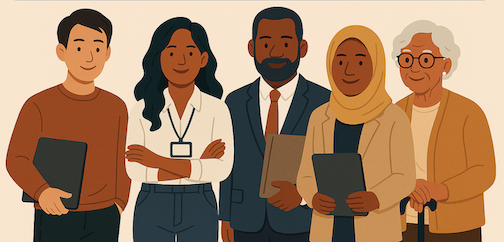
The session pointed out that, currently, there are five generational cohorts in the workforce. Now I am personally skeptical about generational categorization. I think length of experience in the workforce is a more determinative factor than year of birth. But the two things do largely correlate, so maybe that’s just semantics. My only caveat is that while any system of categorization can provide context, all are prone to over generalization. None provide an adequate and reliable solution that can be rigidly and uniformly applied to the leadership dilemma.
So, regardless of how you categorize in order to try and understand them, there are many varieties of life experience in your workforce today. Each brings different needs, expectations and preferences to their role.
One thing is common to ALL of them: they are all coexisting in a workforce struggling to adapt to massive, recent disruptions that haven’t been fully resolved in an environment that continues to face new disruptions at a rapid and unrelenting pace. Things aren’t going to settle down and provide us more certainty any time soon.
There are the obvious external disruptions, from technology (including but not limited to AI), to changing market conditions and business imperatives, and combustible societal and political factors.
But many associations are all still coping with even the basics: an incomplete adaption to a post-COVID workplace and lack of comprehensive agreement on how we are meant to work today. And just as with generational categorization, here we are equally prone to oversimplify: is the “right” approach work from home, return to the office, or hybrid? And while hybrid seems to be the golden mean, exactly what hybrid form, structure, and processes are meant to apply eludes any clear and universally applicable judgment. Flexibility is desirable, but how flexible can we be, and meet both individual and organizational needs? There is no one right way, and many associations are still struggling to find theirs.
So we’re trying to get things right in unsettling and uncertain times. That is not a condition that is conducive to getting the best from people.
To be sure, what we see in the workplace today is just the latest phase in a decades-long evolution from hierarchical, rigid structures of direct authority to more flat, collaborative hierarchies. In that sense, none of this is new.
But we are experiencing it in a particularly acute moment of disruption and uncertainty.
It is all happening so fast and on a massive scale.
The seminar left me with two, overarching take-aways;
- This isn’t going to be solved in a one-and-done manner. We all hunger for a fix that will last at least as long as the models they replace. But it won’t be that simple. It is a truism only because it is true: our only constant is change. We need to be adaptive today, tomorrow and consistently into the future. And the future is coming at us faster than ever.
- Senior management needs to be humble and self-aware. Staff is looking to us for a degree of clarity and certainty that, frankly, we cannot provide for them. While, with maturity, we may have a higher tolerance for ambiguity, senior management is also struggling to find the right norms of operation as a team themselves. And we are people too, just as vulnerable to doubts and uncertainty as people are in the structures lower down in the overly simplified concreteness intended to be conveyed in an organizational chart.
But as leaders something more is called for from us. What we are called to do is approach these conditions with a reality-based, but constructive and positive attitude. Not naïve sophistry, but not defeatism either. Acknowledge rather than downplay or dismiss the validity of what people are feeling. But also act in firm assurance that, while we don’t have absolute answers to all their concerns now, this is solvable.
That solution won’t come as edicts from on high; they will have to be crafted collectively. Something is called for from every member of staff, not just the c-suite. But the promise of reward is there.
Oh, and then there is the dynamic of effective leadership as a staff and the contiguous dynamic of effective leadership from voluntary governance.
It should be fun. It is certainly a challenge.
While generative AI has been used to create the accompanying graphic, I do not use AI tools in composing the content.



 Golden's Rules for Associations