The Board-Staff Disconnect

I have always viewed governance as the most critical role for the association CEO, and by governance I specifically mean the CEO’s function as the point of engagement between the board and staff.
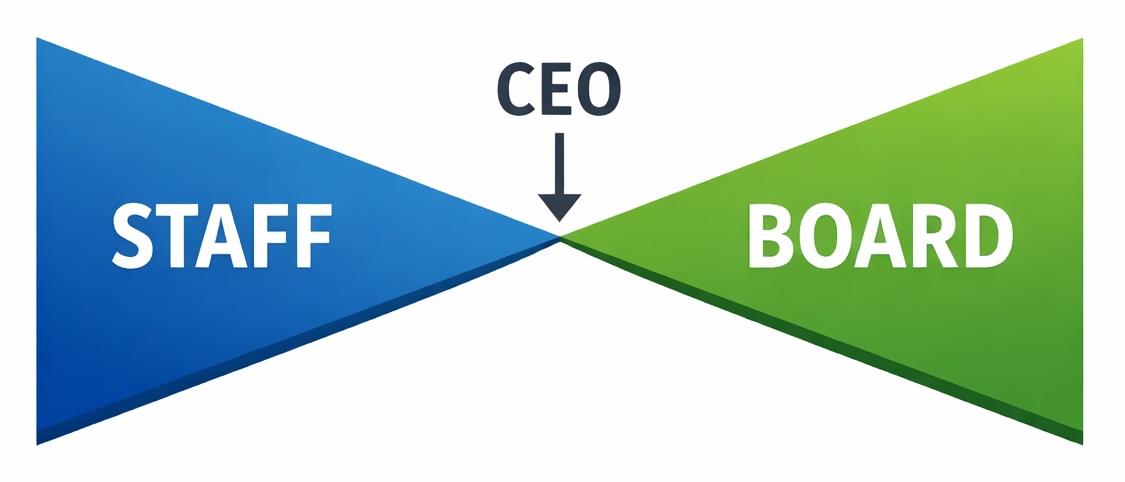
There is an element of hierarchy to this, but org charts don’t adequately capture it. It’s a function of communication, coordination, facilitation and empowerment, to be sure. But it goes so much deeper than that. It is all about maximizing the synergy between the professional competencies unique to each side of the board/staff divide. The voluntary board and the paid professional staff each brings skills, knowledge, and expertise that the other lacks and the organization needs. The CEO alone operates in the shared space between them. The success of the enterprise lies on his/her ability to effectively engage with the board within their paradigm and engage with the staff within theirs. 

Most boards recognize and respect the differences between board and staff roles. But the established way of expressing these differences, while all valid, are also insufficient. To wit: 

  • The board sets direction and the professional staff implements. (Sometimes the metaphor of a bicycle is used: the board is the front wheel that steers; the staff is the rear wheel that drives.)
  • The CEO works for the board; all other staff work for the CEO.
  • The CEO leads operations; the board provides oversight.

Like I said, none of these are actually wrong. They are all just incomplete.

And there is evidence that the gap in understanding between boards and CEOs over the effectiveness of these conceptual models is very real. Spencer Stuart released a study that asked “Do you feel the board gives the CEO effective support to address a rapidly evolving and complex business environment?” 43% of boards answered yes, but only 22% of the CEOs did. And in no universe would even the higher number be a passing grade.

So what is missing?

A recently concluded, 18-month community dialogue into the Future of Association Boards (FAB) offers some insight.

Stewardship

First and foremost: There is a missing element in most measures of performance and success. That element is an overarching and explicit commitment to stewardship. 

It’s not about focusing on progress toward established goals (too often captured in strategic plans that end up being fuzzy, aspirational statements burdened with tactical “solutions” that fail to actualize them in a rapidly changing world). It’s not about a glowing “year in review” summarizing accomplishments. Even less about a chief elected officer being able to talk about the accomplishments of “his or her year in the chair.” And of course, you want to be able to do all those things authentically. 

Stewardship is something more. It is about leaving the organization itself better than you found it, for the benefit of both current stakeholders and their successors in membership, on the board, and in the field.

It isn’t that a sense of stewardship has necessarily been absent. It is just that it has too often been one of those “understood” and unspoken obligations and too often taken for granted. It needs to be brought out of the shadows and made an explicit and driving force in every decision.

Foresight

The key to effective stewardship is exercising foresight: more time focusing on anticipating and understanding the next disruption that, if missed, could mean an opportunity squandered or a blow to be suffered. The American Society of Association Executive’s ForesightWorks is a rich source for understanding and framing the kinds of discussions associations should be having.

Foresight has implications for programs and initiatives, but also for the governance structures created to support them.

True Partnership

The key to making stewardship and foresight happen is a higher degree of partnership between boards and staff than exists today. And the key to making that happen starts with a clearly stated and shared commitment between the chief elected and the chief staff officer:

  • With the chief elected officer accepting primary responsibility for improving board competence and performance[1] and 
  • The chief staff officer (and their senior management team) accepting primary responsibility for doing more than advising boards on issues within their specific functional roles, but as meaningful collaborators in the board’s exercise of stewardship and foresight.

And let me be clear: while there are ways that boards need to change[2], the accountability lies squarely on the CEO to create the means and opportunity for this happen. 

Circle back to my opening thought of the CEO as the person with a foot in both the voluntary and professional staff worlds. That’s the tough assignment we all signed on for.

Disclaimer

The ideas contained here are my own. I do not speak for any organization or company.

AI was used to generate the image accompanying this post. I do NOT use AI to research, generate or edit drafts. 


[1] How often can board members end their term in office feeling like the next person in the seat is joining a board better equipped to be even more effective?

[2] While we typically talk about “volunteer boards,” the FAB dialogue brought focus to the fact that while accepting service on a board is voluntary, once you have accepted that role the legal, fiduciary and ethical obligations to the organization (including stewardship and foresight) are the same as those for paid directors of for-profit corporations. That’s why an awareness of voluntary leadership’s accountability for stewardship and foresight is so important.
Customer or Member?

My association faced a challenge common to many if not all membership organizations: the imperative to diversify revenue sources and monetize our content expertise. Attacking that problem led to a shift in our business mindset.

I know many associations are uncomfortable with the word customer. We are purpose driven organizations, not commercial, commodity retailers. True enough. And lose sight of that fact even for a moment at your extreme peril.

But our association had accumulated a vast and unparalleled inventory of assets (content, programs, activities), derived from our unique expertise and designed by and for our membership to advance our tax-exempt purpose. Yet the actual consumers of those products and services already included a huge number of non-members (sponsors, exhibitors, authors, non-member attendees, non-member content seekers, etc.) 

In a word, customers. 

These were people who saw value in something we were already doing. Through their purchasing behaviors, even though they weren’t members, they were advancing our ability to honor our mission by generating needed financial resources.

Breaking the Member/Non-Member Perspective

But describing them as “non-members” is a self-limiting paradigm. It suggests that the best avenue to expanding the market is a “conversion to membership” strategy. This typically defaults to a focus on expanding membership[1] by broadening definitions of eligibility or creating specialty membership categories as the only ways to increase the market for what the association has to offer. But it isn’t the only way. 

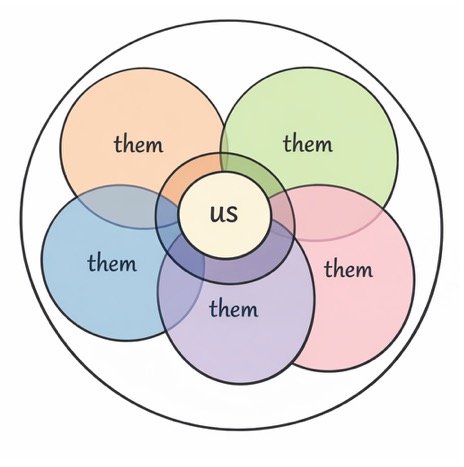
So instead of thinking of the world as divided between members and non-members, we simply started thinking of EVERYONE as customers. 

  • Some of those customers choose to buy membership.
  • Some of those customers choose to buy membership AND other products or services. 
  • Some of those customers choose to buy something (or many things) but NOT the membership product. 

Some of that last category of customers are perhaps (and probably appropriately) excluded from membership. But the important thing is to simply recognize that, even if eligible, some aren’t interested and probably never will be interested in purchasing the membership product. Those are the potential customers you are leaving behind if you are marketing exclusively within a membership context.

I am NOT suggesting abandoning membership building strategies. But this simple change in perspective, exposes new possibilities that can be pursued in addition to and in coordination with those efforts. 

Market and Membership are Not Synonyms

So we have customers. Some buy membership. Others do not. They are all part of our potential market if we just define the product offerings in a way that appeals to their needs and is not limited to those intended to establish a membership connection[2].

This line of thinking was heavily influenced by Amith Nagarajan’s The Open Garden Organization (2018), but the idea that everyone is a customer, some of whom might buy membership and others who never would, had already been planted (pun intended) in my mind before I read it. It’s a book worth looking into if it is not familiar to you and I owe a deep debt of gratitude to Amith for helping me crystalize and articulate the strategy within my association.

This customer paradigm led to:

  • A comprehensive, disciplined, and hard data-driven assessment of the market for every product (including but not limited to membership) in our existing portfolio[3];
  • Enabling us to start separately defining who were potential customers for each marketable offering (including but not limited to membership); in order to 
  • Define marketing strategies customized for each.

This analysis, in turn, led to an association rebranding, market repositioning and name change.

Changing How, Not What

Adapting a customer mindset didn’t require changing WHAT the association was offering (although ideas for new products and strategic unbundling of existing offerings will certainly emerge). Rather, it brought precision to HOW we packaged, priced, and marketed each existing offering. It wasn’t about finding something new that needed to be created[4]. But it vastly increased the horizon for how and where we might access new customers for our existing inventory of offerings (including but not limited to membership[5]).

Not just: what do we need to do to attract more customers as members? (Though we still need to do that.) Instead: what are we already doing that might resonate with those for whom membership is not desired?

Strengthening the Membership Value Proposition

Perhaps paradoxically, thinking of membership as just one of many products available to customers, does not devalue membership. It in fact preserves and protects the membership product itself. Membership remains the organization’s core purpose, its reason for being, and its engine for new value creation. It is what empowers us to achieve, collectively, what members of the profession cannot achieve on their own. 

But rather than diluting the value of membership by trying to make it more attractive to more people with a looser connection to our mission (a questionable marketing strategy at best), our crown jewel (membership) can be stewarded and thrive, immune from mission distractions into new features of membership that often lead to mission creep. 

And viewing membership as a unique product (or bundling of products) made the need to adapt unique marketing and pricing of even the membership product clear. Effective membership marketing requires something different than effective marketing of more transactional and consumable offerings. Membership appeals for different reasons. Adopting marketing approaches specific to this product offers the promise of increasing our effectiveness in how we actually go about increasing membership.

A Blue Ocean Strategy

This customer paradigm also (at least in theory) reduces the threat to adjacent (and usually much larger) membership organizations. We weren’t coming after “their” members to make “us” their membership home. It was just looking at some small segment of their membership that marginally overlapped with ours for customers who might be interested in buying something other than membership that we had available. Offerings that were well within our scope and capacity, but in most cases, were too marginal to the larger, homebase organization’s mission for them to effectively satisfy themselves without losing focus[6].

Ergo, minimized potential for counterproductive membership competition and redundancy of products in the market. It’s a blue ocean rather than a red ocean strategy. 

It is still early days, but the potential exists, if trust can be built, for future, multi-association collaborations to cooperatively and better meet the needs of that small sliver of customers where overlap exists. But first things first. We needed to get started.

Disclaimer

The ideas contained here are my own. I do not speak for any organization or company.

This case study describes something that was still in its earliest stages when I left the organization. There was still a huge amount of work to do to execute the strategy described. Time will tell if it is sustained or successfully realized.

The opinions expressed (and any errors) are entirely my own.

AI was used to generate the image accompanying this post. I do NOT use AI to generate or edit drafts. 


[1] Too often, expanding membership really ends up reducing the close connection to our core and causing mission creep, which ends up undermining the unique membership value proposition you started with. 

[2] Non-member pricing of a la carte membership offerings is a baby step in this direction but is still locked in a market=membership paradigm. Increasing membership remains a valid, even critical function. It is just a separate and different strategy than the one I am focusing on here.

[3] We didn’t just ask our board who they thought “ought” to value what. They were one, but only one of the segments focus grouped or surveyed. Then we tested their assumptions with wider surveys and focus groups.

[4] That is a separate and equally critical imperative for every association.

[5] I know that is the third time in two paragraphs I’ve used that phrase. But thinking of your portfolio as “including but not limited to membership” is critical to the customer mindset. It’s how you condition yourself to view every offering with your membership as but one of the potential markets for it.

[6] In the interest of full disclosure: many of those adjacent organizations were understandably skeptical that our strategy wasn’t a threat to them. Seeing how it leaves them a clearer field to focus on their own core competencies and membership value proposition will only occur if our actual actions match our intentions. 

Adaptive Leadership: It Will Never Be One-and-Done

I had the opportunity today to participate in a very stimulating ASAE Academy session on “The Adaptive Leader.” Some thoughts emerged …

To start with a statement of the obvious: organizations are more than their structured resources. They’re made up of people. And no matter how clear the mission and how abundant or well managed the systems and resources (financial, human, intellectual property, technology), it all is for naught if the people aren’t effectively supported, empowered, and engaged within the workplace.  

But people are complicated. They can’t be systematized. 

That challenge is not new, it’s just most severe today.

The session pointed out that, currently, there are five generational cohorts in the workforce. Now I am personally skeptical about generational categorization. I think length of experience in the workforce is a more determinative factor than year of birth. But the two things do largely correlate, so maybe that’s just semantics. My only caveat is that while any system of categorization can provide context, all are prone to over generalization. None provide an adequate and reliable solution that can be rigidly and uniformly applied to the leadership dilemma. 

So, regardless of how you categorize in order to try and understand them, there are many varieties of life experience in your workforce today. Each brings different needs, expectations and preferences to their role.

One thing is common to ALL of them: they are all coexisting in a workforce struggling to adapt to massive, recent disruptions that haven’t been fully resolved in an environment that continues to face new disruptions at a rapid and unrelenting pace. Things aren’t going to settle down and provide us more certainty any time soon.

There are the obvious external disruptions, from technology (including but not limited to AI), to changing market conditions and business imperatives, and combustible societal and political factors.

But many associations are all still coping with even the basics: an incomplete adaption to a post-COVID workplace and lack of comprehensive agreement on how we are meant to work today. And just as with generational categorization, here we are equally prone to oversimplify: is the “right” approach work from home, return to the office, or hybrid? And while hybrid seems to be the golden mean, exactly what hybrid form, structure, and processes are meant to apply eludes any clear and universally applicable judgment. Flexibility is desirable, but how flexible can we be, and meet both individual and organizational needs? There is no one right way, and many associations are still struggling to find theirs.

So we’re trying to get things right in unsettling and uncertain times. That is not a condition that is conducive to getting the best from people. 

To be sure, what we see in the workplace today is just the latest phase in a decades-long evolution from hierarchical, rigid structures of direct authority to more flat, collaborative hierarchies. In that sense, none of this is new.

But we are experiencing it in a particularly acute moment of disruption and uncertainty.

It is all happening so fast and on a massive scale.

The seminar left me with two, overarching take-aways;

  1. This isn’t going to be solved in a one-and-done manner. We all hunger for a fix that will last at least as long as the models they replace. But it won’t be that simple. It is a truism only because it is true: our only constant is change. We need to be adaptive today, tomorrow and consistently into the future. And the future is coming at us faster than ever.
  2. Senior management needs to be humble and self-aware. Staff is looking to us for a degree of clarity and certainty that, frankly, we cannot provide for them. While, with maturity, we may have a higher tolerance for ambiguity, senior management is also struggling to find the right norms of operation as a team themselves. And we are people too, just as vulnerable to doubts and uncertainty as people are in the structures lower down in the overly simplified concreteness intended to be conveyed in an organizational chart. 

But as leaders something more is called for from us. What we are called to do is approach these conditions with a reality-based, but constructive and positive attitude. Not naïve sophistry, but not defeatism either. Acknowledge rather than downplay or dismiss the validity of what people are feeling. But also act in firm assurance that, while we don’t have absolute answers to all their concerns now, this is solvable. 

That solution won’t come as edicts from on high; they will have to be crafted collectively. Something is called for from every member of staff, not just the c-suite. But the promise of reward is there.

Oh, and then there is the dynamic of effective leadership as a staff and the contiguous dynamic of effective leadership from voluntary governance.

It should be fun. It is certainly a challenge. 

While generative AI has been used to create the accompanying graphic, I do not use AI tools in composing the content.