Why ‘Trust the Experts’ Isn’t Working … And What Might

A few months back, I wrote about “Truth Under Fire” in an age of decentralized information, public distrust in institutions and credentialed authority, and AI/social media-driven echo chambers that value divisiveness and conflict over reasoned dialogue and mutual benefit. 

In that post I asserted ‘We are long past an environment where we can simply put out the data and trust the facts to speak for themselves. The truth demands effective advocacy … Too often, however, no matter how pure our intentions and our intended tone, our advocacy is received as “You are wrong. Trust us. We know better than you do.” Even worse, too often, the message is communicated in overly aggressive language that communicates: “That’s misinformation and you’re an idiot for listening to it.’”

Nowhere is this more in view than in the field of science. I recently stumbled upon a fascinating post from a scientist and communications specialist (Rick Borchelt) that resonated with these ideas. It deserves to be read in full, but in summary:

Borchelt had just returned from the 2026 American Academy for the Advancement of Science (AAAS) annual meeting feeling deeply discouraged. His core critique was that the science community has largely failed to absorb decades of research on science communication and is poised to repeat its past mistakes.

He cited two specific pieces of the literature to bolster his point: 

  • John Ziman’s 1991 paper debunking the “knowledge deficit” theory: the idea that the public just needs more facts and better storytelling to trust science.
  • Sheila Jasanoff’s work in the early 2000s calling on scientists to abandon the positivism (all truth derives from observable phenomena and scientific inquiry) that has resulted in the perceived hubris of expertise that only reinforces the non-expert’s distrust.  

His bottom line: rather than showing some humility, rather than acknowledging that sometimes past (and even validly reached) scientific judgments have been proven wrong overtime, and most importantly, rather than approaching disagreements with respect for the other side’s concerns and a genuine commitment to mutual understanding, the science community appears ready to double down on polarizing public protests that assert science’s superiority over all comers. He sees this as exactly the wrong response to the current moment.

It’s a pointed critique from an insider, someone who is himself an AAAS Fellow and career science communicator.

And I fear that Borchelt (an apparently accomplished and respected scientific communicator himself) may place too much confidence in the power of effective communication to fix things. The atmosphere of distrust may run too deep for that. As ASAE’s ForeSight work has stated: “pressure on the truth is not a passing data or communications problem. It is a core leadership challenge.” (I suspect Borchelt would probably agree.)
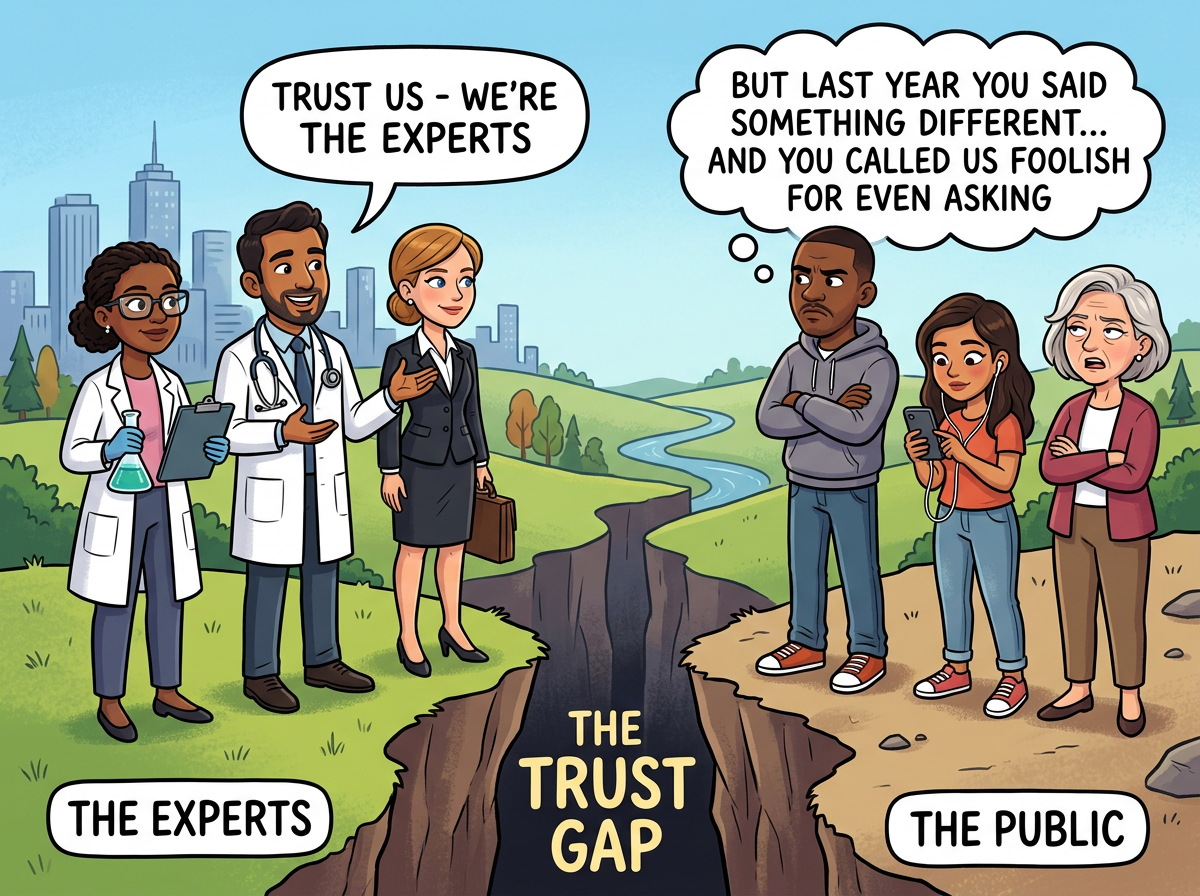
But as I stated in my earlier post, “It isn’t about winning the war between MY facts and YOUR misinformation. It’s about applying what can be known, reliably, to fixing the thing that made [someone an anti-science] advocate in the first place.” Because it isn’t necessarily that they disbelieve science. They just don’t believe the people who assert they are its spokesperson and must be listened to. And they don’t care about your science; they care about their problem and see little evidence that you do, too.

We have to break that cycle of zero-sum advocacy (I only win if you lose) from both sides in order for civil discourse to occur … the kind of discourse that might lead to restored trust and actually advancing the common good. 

I should emphasize that although in most cases bad information is simply misinformed opinion, that isn’t always the case. Too many times those relying on “authoritative truth” are not acting in good faith, deploying expertise designed to mislead and misdirect. (Think of the tobacco industry’s efforts to challenge the science around the health effects of smoking with alt-science of their own.)

And this “truth under fire” environment is absolutely NOT happening only in the field of science: And it’s NOT only happening on the scale of “Capital S Science vs. the MAHA movement.”

Every day ANY professional seeking to apply their advanced skills and truly authoritative knowledge to serve a valid need faces the same challenge. 

To cite just one example: a legal professional dealing with a client or potential client who is wondering why they should use their services rather than just using free AI to generate a will or other legal document. “Trust me, I know what you need better than you do” is not likely to be a winning strategy there, either.

 Disclaimer

The ideas contained here are my own. I do not speak for any organization or company.

AI was used to generate the image accompanying this post. I do NOT use AI to generate or edit drafts. 

Why these things matter

Get involvedChances are that if you are reading this, you consider yourself an association professional and you appreciate the tremendous good that associations do for society. You are probably also concerned about some of the issues impacting associations, and maybe even support advocacy by groups like ASAE to address them.

But do you ever involve the boards and membership of your own association in these matters?  Probably you consider these issues too much “inside association baseball” for that.

But wait a minute.  If your association’s ability to interact with the agency that regulates your members were curtailed, wouldn’t that have an impact on your association’s ability to meet your members’ needs? If the net dollars your association has to spend on association programs were reduced by taxation, wouldn’t that impact the level of service you deliver to your members?

Recognition of the positive impact that associations have upon society and what constitutes the appropriate level of taxation and regulation upon their activities matters to more than just association professionals.  They matter — or at least they should — to your association’s membership, too.

Read more in my latest Association TRENDS commentary, here.

The myth about ‘special interests’

Much of the public thinks of associations as “special interests” who do nothing but lobby the system to game advantage (even though U. S. government data shows that associations spend many times more on educational activities than on lobbying).

In my opinion, “special interest” is a pejorative only when applied to a group whose interests we don’t share. No. If we were to be honest with ourselves, we are, each of us, members of dozens of special interests, based on our jobs, the communities we live in, the needs of our families, our beliefs and our passions.

And when individuals with a shared interest come together to advance their own cause in a way that also serves society, it is a thing of beauty.  It is perhaps ironic that a quintessentially Washington evening in celebration of “special interests” did such a powerful job reminding us of that fact.

Read my latest commentary in AssociationTRENDS to learn why I think it so important for events like ASAE’s 13th annual Summit Awards Dinner last week to showcase how much good associations do.

The myth about ‘special interests’

Looking into the congressional crystal ball

Associations have garnered their share of attention from the Hill in the last year, but no one expected a thoroughly gridlocked Congress to actually get anything done about it … at least until after the election.  And after that?   Read my latest commentary in AssociationTRENDS to learn why I don’t think any of the association issues already in play will be the headline legislative issues for associations in the year ahead.

Looking into the congressional crystal ball

The Generation Gap in Lobbying

There is a generation gap between lobbyists and the lobbied that requires rethinking established GR tactics.  Read my commentary from this week’s Association Trends.


Paradigms

I recently suffered a very sudden and very significant loss of vision.  Happily, the condition was fully correctible. Nonetheless, during the period of impairment I learned some very interesting things about how the brain works and we perceive the world.

I discovered that when I was in familiar surroundings, my brain could reach back to stored memories of how things were supposed to look.  In the familiar confines of my office or home, I hardly noticed the lack of clarity in my vision.  My brain was able to easily recognize the settings and the people I encountered and adjusted things to make it feel like I could see better than I actually did.

When I went on a period of extended travel, however, and found myself in unfamiliar surroundings, the visual impairment felt like it became more severe.  Everything was a total blur.  I felt disoriented and at a loss. 

Scientists talk about the concept of paradigms: the frame of reference that causes the human brain to routinely “fill in the blanks” and add information to what we are actually, sensually perceiving.  When that additional information is accurate, it actually improves our grasp of reality, as was the case when I was navigating my office and home with my fading eyesight. 

But sometimes the information that our governing paradigms add to our perceptive abilities can be misleading.  We can essentially see what we are expecting to see, not what is actually before us. 

And paradigms don’t just have the power to change — and distort — visual perceptions. I have seen paradigms at work within human interactions as well.    

When that happens, at a board meeting, or a staff meeting, or a legislative meeting, it can start an argument where there is no disagreement.  The conversation never gets to the available, mutually beneficial solution because the parties are too distracted arguing over perceived differences that exist only in their conflicting paradigms.

Or, put another way, if we remain at loggerheads, locked inflexibly into opposing positions even where there is no real impediment to a satisfactory solution, we will never get to a position of strength, from which we can successfully negotiate an acceptable outcome on the issues that truly do matter to us. 

Sometimes, you just have to let go of your paradigm.

Inquiry or advocacy?

There are two kinds of public policy research:  there is inquiry and there is  advocacy.  In the case of advocacy, you start with an answer and go in search of the facts that will bolster and support your position.  In the case of inquiry, you start with a question and let the facts lead you where they may.

It is important to understand the difference.  I have seen too many cases where association lobbying efforts have gone horribly wrong because someone got so excited about the case it was possible to make for their desired outcome by carefully selecting their facts that they ignored even the most obvious data that could be used against it.  And their beautiful, fact-based strategy collapsed the first time it was challenged.

Effective association advocacy requires both forms of research.  Before the association begins to craft its legislative or regulatory strategy, it needs a good, clear headed and pragmatic understanding of what the facts of the situation actually are.  It is like the intelligence gathering that gets done before you plan a military campaign.  Just because naval warfare is your particular strength, you can’t start planning a water-based assault on your enemy without first checking into whether key targets are accessible by water.

If the inquiry is open and honest, you sometimes learn something unpleasant that you won’t like hearing.  But that can be even more important than getting the answer you wanted.  If naval warfare is your particular strength, but the rivers are too shallow for your ships, that is a setback.  But you’re better off knowing it before you’ve committed your navy.

Sometimes the research merely confirms what you already knew.  Understandably, that kind of research often gets criticized by members as a waste of time and resources.  But if the stakes are high enough, if the issue is of life and death importance, it doesn’t hurt to verify and confirm the reliability of the assumptions you are betting the industry’s future on.  To further torture the naval warfare metaphor, it might be “obvious” that the city you need to capture is accessible by the river. “We don’t need some high price mapmaker to point that out.”  But before putting your military personnel’s lives on the line, it would be nice to know for sure and to have maps with the river depths precisely charted for your ships to follow.

Both forms of research require intellectual honesty.  Spinning the facts to serve your purpose to such an extent that you distort reality is not an example of either inquiry or advocacy research.  In fact, it isn’t even research at all.  It is
dishonest salesmanship masquerading as research.  And the only mark you are duping with the deceptive sales pitch is yourself.