Why ‘Trust the Experts’ Isn’t Working … And What Might
1 April 2026 Leave a comment
A few months back, I wrote about “Truth Under Fire” in an age of decentralized information, public distrust in institutions and credentialed authority, and AI/social media-driven echo chambers that value divisiveness and conflict over reasoned dialogue and mutual benefit.
In that post I asserted ‘We are long past an environment where we can simply put out the data and trust the facts to speak for themselves. The truth demands effective advocacy … Too often, however, no matter how pure our intentions and our intended tone, our advocacy is received as “You are wrong. Trust us. We know better than you do.” Even worse, too often, the message is communicated in overly aggressive language that communicates: “That’s misinformation and you’re an idiot for listening to it.’”
Nowhere is this more in view than in the field of science. I recently stumbled upon a fascinating post from a scientist and communications specialist (Rick Borchelt) that resonated with these ideas. It deserves to be read in full, but in summary:
Borchelt had just returned from the 2026 American Academy for the Advancement of Science (AAAS) annual meeting feeling deeply discouraged. His core critique was that the science community has largely failed to absorb decades of research on science communication and is poised to repeat its past mistakes.
He cited two specific pieces of the literature to bolster his point:
- John Ziman’s 1991 paper debunking the “knowledge deficit” theory: the idea that the public just needs more facts and better storytelling to trust science.
- Sheila Jasanoff’s work in the early 2000s calling on scientists to abandon the positivism (all truth derives from observable phenomena and scientific inquiry) that has resulted in the perceived hubris of expertise that only reinforces the non-expert’s distrust.
His bottom line: rather than showing some humility, rather than acknowledging that sometimes past (and even validly reached) scientific judgments have been proven wrong overtime, and most importantly, rather than approaching disagreements with respect for the other side’s concerns and a genuine commitment to mutual understanding, the science community appears ready to double down on polarizing public protests that assert science’s superiority over all comers. He sees this as exactly the wrong response to the current moment.
It’s a pointed critique from an insider, someone who is himself an AAAS Fellow and career science communicator.
And I fear that Borchelt (an apparently accomplished and respected scientific communicator himself) may place too much confidence in the power of effective communication to fix things. The atmosphere of distrust may run too deep for that. As ASAE’s ForeSight work has stated: “pressure on the truth is not a passing data or communications problem. It is a core leadership challenge.” (I suspect Borchelt would probably agree.)
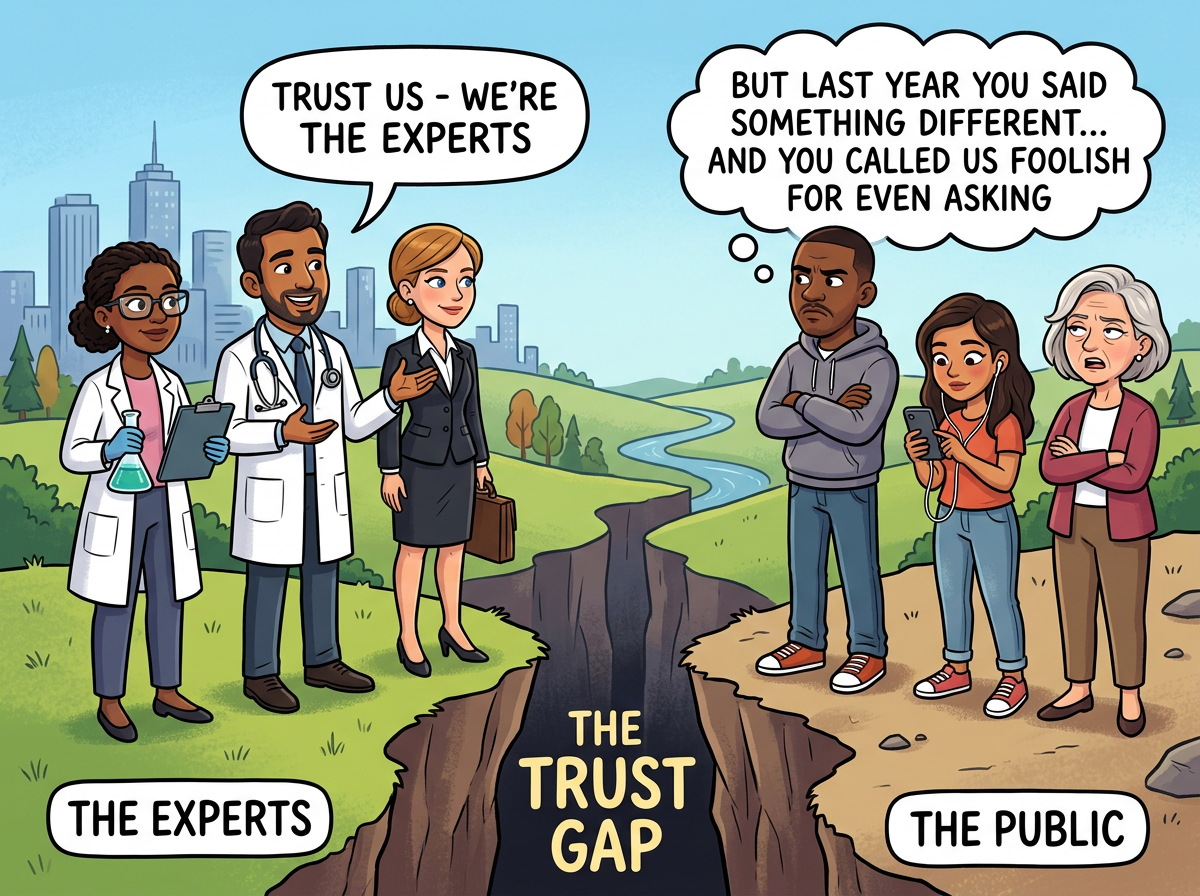
But as I stated in my earlier post, “It isn’t about winning the war between MY facts and YOUR misinformation. It’s about applying what can be known, reliably, to fixing the thing that made [someone an anti-science] advocate in the first place.” Because it isn’t necessarily that they disbelieve science. They just don’t believe the people who assert they are its spokesperson and must be listened to. And they don’t care about your science; they care about their problem and see little evidence that you do, too.
We have to break that cycle of zero-sum advocacy (I only win if you lose) from both sides in order for civil discourse to occur … the kind of discourse that might lead to restored trust and actually advancing the common good.
I should emphasize that although in most cases bad information is simply misinformed opinion, that isn’t always the case. Too many times those relying on “authoritative truth” are not acting in good faith, deploying expertise designed to mislead and misdirect. (Think of the tobacco industry’s efforts to challenge the science around the health effects of smoking with alt-science of their own.)
And this “truth under fire” environment is absolutely NOT happening only in the field of science: And it’s NOT only happening on the scale of “Capital S Science vs. the MAHA movement.”
Every day ANY professional seeking to apply their advanced skills and truly authoritative knowledge to serve a valid need faces the same challenge.
To cite just one example: a legal professional dealing with a client or potential client who is wondering why they should use their services rather than just using free AI to generate a will or other legal document. “Trust me, I know what you need better than you do” is not likely to be a winning strategy there, either.
Disclaimer
The ideas contained here are my own. I do not speak for any organization or company.
AI was used to generate the image accompanying this post. I do NOT use AI to generate or edit drafts.
 About Mark J. Golden, FASAE, CAE


 Golden's Rules for Associations