What does “going global” really mean?

It’s a question that frequently arises in conversations among my association peers. Every one of my associations has been U.S.-based but, to some degree, operated globally.[1]. And what I have learned is, like with so many questions of this kind, the answer always must start with “it depends …”

For a U.S. based association, aspiring to expand globally, I can identify at least four domains of possible activity:

Market and Revenue Enhancement

This is probably where most associations start when they are thinking about going global. What are the products or services (existing, repurposed, or new) that could be delivered outside the U.S. to generate revenue? Major caveat: there always needs to be mission consistency. Approaching international markets purely as potential ATMs for extracting revenue is not only naïve, but almost never successful. And, in my view, it is never legitimate. There needs to be a return on investment to the mission for every association offering. If it also happens to be financially lucrative, so much the better.

In some areas of the world, and depending on the scale of the program, this might require setting up overseas operations just to get in country. But not always.

Even if you are not setting up a satellite office, to be truly effective, operations in the U.S. for delivery overseas of even a single product offering requires more than just a cooperative local member in the target country. An individual member who can provide a facility to host your international event may not have the juice to attract local attendees, sponsors, and exhibitors, or the savvy to accommodate local regulatory requirements, or an understanding of what’s involved in a project of this sort. You need strong and accountable local partners, competent in the business and operational skills you aren’t present to provide directly. (And don’t get overconfident in your own ability to effectively provide marketing, sales and onsite management of operational support half way around the world.) It takes discipline to hold yourself to that requirement.

Diplomatic

Your association may be eligible for membership as the U.S. representative in an international federation. This one is tricky. In many cases the U.S. association is larger in terms of finances, scope of operations, content expertise, and staff than any other member of the federation, or even the combined resources of the federation as a whole. The federation (and its national or regional members) might value the relationship as an avenue of access to information and resources unavailable without you. But exercising your presence with too heavy a hand can cause more damage than good. (The global federation will always harbor the fear that you are after usurping their title as THE international representative of the field.)

On the other hand, if handled with diplomacy and tact, it is often very easy for your association to gain an impactful role within the federation in ways that advance your own parochial interests. Simply being more competent and experienced in association management can translate into appreciated and influential involvement.

Maintaining an actual presence and engagement in international federations is costly, both financially and in the time and attention managing the relationship consumes. Boards are often insensitive to just how much staff time and effort is consumed in ensuring that the President always gets invited to the international meeting and that we respond to every request for a “strategic alliance.” 

But when budgets are tight, the question of “what are we actually getting out of this?” comes up. And the answer is often soft (and suspect): showing leadership, adding prestige. It usually comes down to FOMO.

But sometimes this is something you still need to do; 

  • As a show of solidarity with the profession/industry, 
  • To stay in the loop on what’s going on beyond U.S. borders, and 
  • To enhance your brand. 

Being able to document specific accomplishments linked to participation is necessary.

Beyond any formal international federation, there may be opportunities for bilateral relationships with similar, usually national organizations outside the U.S. My one caveat here is: if you are going to do this, make the relationship specific, appropriately scaled, and one in which both parties get concrete value and are held accountable to each other. 

Don’t fall into the MoU trap, where just having as many resolutions to frame and hang on the board room wall is your metric of success. The management time and attention necessary to maintain even this Potemkin Village of international presence can be significant.

Developmental

This is the one that personally excites me most: delivery of your association’s knowledge and expertise, directly and in service to less developed countries. I am particularly proud of one of my association’s program sending teams of members to meet with their counterparts in countries in the developing world, providing practical support in areas of professional practice and impact. We sent such missions to more than 20 countries over the course of the past decade and provided post-mission (albeit, virtual) follow up and support. This is all cost, no financial return. It is huge for the local community but can’t, by itself, move the needle globally. Yet, to the extent you can provide it, it is the truest form of global mission impact for your U.S.-based association.

Collaboration/Engagement Opportunities for your own Members and Constituents.

This one gets overlooked but can be significant. As noted above, maintaining engagement in international federations is costly. But always remember to factor in the value of the opportunities it creates for individual members to participate in activities, such as research, publication credits, speaking opportunities, committee service, etc. It may be easier for a member to get a speaking role at the federation’s comparatively smaller meeting than national’s mega-conference. (This is particularly important in fields where “publish or perish” is a career imperative.)  This is also a way to identify and develop younger or early career members for future roles in the U.S. association. 

The management challenge here is maintaining meaningful contact and coordination with the individuals thus engaged. They may be your association’s appointed representative on the federation’s XYZ Council, but that does neither you nor them any good if neither is aware of what the other has going on.

In most cases, going global involves some combination of the above. And just to keep things even more interesting, the categories sometimes bleed into each other and can sometimes come into conflict (usually, in competition for resources).

I would be interested in hearing others’ thoughts on the inventory of elements that can go into going global.

Disclaimer

The ideas contained here are my own. I do not speak for any organization or company.

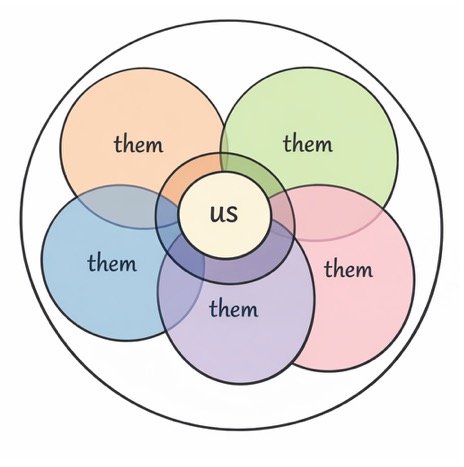
AI was used to generate the image accompanying this post. I do NOT use AI to generate or edit drafts. 


[1] Ironically, the presence or absence of “international” in an association’s name is not always a useful indicator of its degree of global-ness. My first association was the only one with “international” in its name, and it had the least to show for its global aspirations. My three most recent CEO gigs were with organizations that had either “national” or “American” in their names, and these had more substantive and meaningful international presence. (And in one case, this led to changing the association name to remove “American.”)
Customer or Member?

My association faced a challenge common to many if not all membership organizations: the imperative to diversify revenue sources and monetize our content expertise. Attacking that problem led to a shift in our business mindset.


I know many associations are uncomfortable with the word customer. We are purpose driven organizations, not commercial, commodity retailers. True enough. And lose sight of that fact even for a moment at your extreme peril.

But our association had accumulated a vast and unparalleled inventory of assets (content, programs, activities), derived from our unique expertise and designed by and for our membership to advance our tax-exempt purpose. Yet the actual consumers of those products and services already included a huge number of non-members (sponsors, exhibitors, authors, non-member attendees, non-member content seekers, etc.) 

In a word, customers. 

These were people who saw value in something we were already doing. Through their purchasing behaviors, even though they weren’t members, they were advancing our ability to honor our mission by generating needed financial resources.

Breaking the Member/Non-Member Perspective

But describing them as “non-members” is a self-limiting paradigm. It suggests that the best avenue to expanding the market is a “conversion to membership” strategy. This typically defaults to a focus on expanding membership[1] by broadening definitions of eligibility or creating specialty membership categories as the only ways to increase the market for what the association has to offer. But it isn’t the only way. 

So instead of thinking of the world as divided between members and non-members, we simply started thinking of EVERYONE as customers. 

  • Some of those customers choose to buy membership.
  • Some of those customers choose to buy membership AND other products or services. 
  • Some of those customers choose to buy something (or many things) but NOT the membership product. 

Some of that last category of customers are perhaps (and probably appropriately) excluded from membership. But the important thing is to simply recognize that, even if eligible, some aren’t interested and probably never will be interested in purchasing the membership product. Those are the potential customers you are leaving behind if you are marketing exclusively within a membership context.

I am NOT suggesting abandoning membership building strategies. But this simple change in perspective, exposes new possibilities that can be pursued in addition to and in coordination with those efforts. 

Market and Membership are Not Synonyms

So we have customers. Some buy membership. Others do not. They are all part of our potential market if we just define the product offerings in a way that appeals to their needs and is not limited to those intended to establish a membership connection[2].

This line of thinking was heavily influenced by Amith Nagarajan’s The Open Garden Organization (2018), but the idea that everyone is a customer, some of whom might buy membership and others who never would, had already been planted (pun intended) in my mind before I read it. It’s a book worth looking into if it is not familiar to you and I owe a deep debt of gratitude to Amith for helping me crystalize and articulate the strategy within my association.

This customer paradigm led to:

  • A comprehensive, disciplined, and hard data-driven assessment of the market for every product (including but not limited to membership) in our existing portfolio[3];
  • Enabling us to start separately defining who were potential customers for each marketable offering (including but not limited to membership); in order to 
  • Define marketing strategies customized for each.

This analysis, in turn, led to an association rebranding, market repositioning and name change.

Changing How, Not What

Adapting a customer mindset didn’t require changing WHAT the association was offering (although ideas for new products and strategic unbundling of existing offerings will certainly emerge). Rather, it brought precision to HOW we packaged, priced, and marketed each existing offering. It wasn’t about finding something new that needed to be created[4]. But it vastly increased the horizon for how and where we might access new customers for our existing inventory of offerings (including but not limited to membership[5]).

Not just: what do we need to do to attract more customers as members? (Though we still need to do that.) Instead: what are we already doing that might resonate with those for whom membership is not desired?

Strengthening the Membership Value Proposition

Perhaps paradoxically, thinking of membership as just one of many products available to customers, does not devalue membership. It in fact preserves and protects the membership product itself. Membership remains the organization’s core purpose, its reason for being, and its engine for new value creation. It is what empowers us to achieve, collectively, what members of the profession cannot achieve on their own. 

But rather than diluting the value of membership by trying to make it more attractive to more people with a looser connection to our mission (a questionable marketing strategy at best), our crown jewel (membership) can be stewarded and thrive, immune from mission distractions into new features of membership that often lead to mission creep. 

And viewing membership as a unique product (or bundling of products) made the need to adapt unique marketing and pricing of even the membership product clear. Effective membership marketing requires something different than effective marketing of more transactional and consumable offerings. Membership appeals for different reasons. Adopting marketing approaches specific to this product offers the promise of increasing our effectiveness in how we actually go about increasing membership.

A Blue Ocean Strategy

This customer paradigm also (at least in theory) reduces the threat to adjacent (and usually much larger) membership organizations. We weren’t coming after “their” members to make “us” their membership home. It was just looking at some small segment of their membership that marginally overlapped with ours for customers who might be interested in buying something other than membership that we had available. Offerings that were well within our scope and capacity, but in most cases, were too marginal to the larger, homebase organization’s mission for them to effectively satisfy themselves without losing focus[6].

Ergo, minimized potential for counterproductive membership competition and redundancy of products in the market. It’s a blue ocean rather than a red ocean strategy. 

It is still early days, but the potential exists, if trust can be built, for future, multi-association collaborations to cooperatively and better meet the needs of that small sliver of customers where overlap exists. But first things first. We needed to get started.

Disclaimer

The ideas contained here are my own. I do not speak for any organization or company.

This case study describes something that was still in its earliest stages when I left the organization. There was still a huge amount of work to do to execute the strategy described. Time will tell if it is sustained or successfully realized.

The opinions expressed (and any errors) are entirely my own.

AI was used to generate the image accompanying this post. I do NOT use AI to generate or edit drafts. 


[1] Too often, expanding membership really ends up reducing the close connection to our core and causing mission creep, which ends up undermining the unique membership value proposition you started with. 

[2] Non-member pricing of a la carte membership offerings is a baby step in this direction but is still locked in a market=membership paradigm. Increasing membership remains a valid, even critical function. It is just a separate and different strategy than the one I am focusing on here.

[3] We didn’t just ask our board who they thought “ought” to value what. They were one, but only one of the segments focus grouped or surveyed. Then we tested their assumptions with wider surveys and focus groups.

[4] That is a separate and equally critical imperative for every association.

[5] I know that is the third time in two paragraphs I’ve used that phrase. But thinking of your portfolio as “including but not limited to membership” is critical to the customer mindset. It’s how you condition yourself to view every offering with your membership as but one of the potential markets for it.

[6] In the interest of full disclosure: many of those adjacent organizations were understandably skeptical that our strategy wasn’t a threat to them. Seeing how it leaves them a clearer field to focus on their own core competencies and membership value proposition will only occur if our actual actions match our intentions.