Build, Partner or Buy?
19 March 2026 Leave a comment
It’s a classic strategic decision faced whenever an enterprise sees an opportunity to expand its product and service offerings. This is true of for-profit entities as much as it is for associations.
You identify an unmet (or under-met) need within your core membership or target audience and feel it is an opportunity to increase the value proposition of your association. It aligns with your mission and values. It could increase the revenues available to invest in mission-driven functions that are not themselves financially self-sustaining (such as advocacy and public awareness). It could achieve some other non-financial, mission-based return on investment, such as increased member engagement and loyalty. It might even do a little of both. (We call those opportunities “no-brainers.”)
That’s the easy part.
Disciplined Business Planning is Necessary
And not always something even your high performing association is necessarily resourced to do. But you need to do your homework. Is there actual data to support that the market is real? Gather it. Test it. Hard.
Be realistic about your areas of strength and the areas where you are lacking. Coming up with a great idea is easy. Passion for and belief in the concept is critical. But the actual and opportunity costs of any new venture are significant. Commitment needs to be informed and not purely emotional (and not based solely on a brainstorming session by the board).
- Is there a real need for this offering and is the market reachable? (The gap between “there are millions of people who could use this and benefit from it” and successfully penetrating a market is huge.)
- Do we have something unique and otherwise absent from the market to bring to bear?
- Is there anybody else already offering it or better positioned to do so?
- Do we have the patience, resources, and discipline to see it through?
Assuming it passes those tests, you have three choices:

Create the New Business Line Within Your Association
Pros: Total control and you reap all the benefits from a successful new product or service launch.
Cons: You also assume all the risks. Moreover, it takes patience. And it takes resources.
It takes time to create and reach any market with a new offering. And that effort will divert significant management and operational time and attention from your existing programs, as well as consume other tangible resources for a (potentially) long period of time before you start to realize the benefits. Do you have the organizational resources to sustain and does your board have the patience to take the time necessary[1]?
Too often, “do it ourselves” is the default approach for association boards. Why is that often a mistake? Because while your association may have unique value components (your brand reputation in the field you are targeting, your unrivalled expertise and knowledge of the field, established relationships), executing usually requires knowledge and expertise totally unrelated to the field you represent and not currently resident in your organization.
I once led an association that had designed a truly impressive re-purposing of its body of knowledge for the benefit of the general public. No doubt, we had the content expertise to answer questions that consumers needed answers to but had no ready means to confidently answer for themselves. What we lacked were the dollars and the expertise to mount a viable, global mass marketing campaign. We were really good at leveraging social media and websites for people who were already aware of us and who knew we were the go-to source for easily accessible and fully credible information. But on a scale akin to Google or LinkedIn? We lacked the resources and skills to scale our web resources and pierce the noise of mass market communications. We built it; they did not come[2].
Partner with an Entity That Has Resources & Capacity in the Areas You Lack
Pros: If you can find a partner whose capacities complement the assets and value you bring to the table, this can accelerate your ability to get to market, reduce your costs, and shares the risks involved in a new product or service launch.
Cons: You end up with a piece of the pie, not the whole thing. And if your partner is a for-profit entity, there is an inevitable tension between the financial return-driven and mission-driven business paradigms of the two partners that could sour the relationship over time. There is always the risk that you (or more importantly, your board) might chafe at lacking total control of anything with the association’s name on it that might impact your brand reputation. Boundaries between WHO is responsible and WHO has final decision-making authority for WHAT aspects of the joint venture is not always clear, particularly when something external to the offering (your partner’s acquisition by someone else, a new competitor, or some other change in the marketplace) requires pivoting from the original strategy.
Nonetheless, a lot of the typical association non-dues revenue sources fall into this category. Think association-sponsored insurance plans. But there are plenty of more complex joint ventures between associations and between associations and for-profit entities that I could cite.
Buy it
Pros: If there is someone else already doing (or trying to do) what you aspire to do, acquiring them is potentially a turnkey solution requiring only limited re-engineering. You get to market fast with the same end-to-end control as a new build.
Cons: Costly up front. Negotiating the deal and integrating the new entity requires a degree of business management expertise that is not generally resident in an association staff. (Albeit such expertise is readily available on a contract basis.)
Regardless of Approach
In all these cases, you may be entering a red ocean of incumbent competitors with similar offerings that, while not as uniquely customized to your membership’s needs, enjoy superior market presence and awareness. Don’t under-estimate them or over-estimate the extent and power of your association’s brand.
And there is always the danger of mission creep. If the new initiative wildly succeeds (or you lack the discipline to cut losses on one that is failing), it can overshadow your association’s actual reason for being.
So What Is an Association to Do?
- Build for the long-term, if you have or can realistically acquire all the necessary skills and capacity.
- Partner if you need to move fast.
- Acquire if you have the financial resources and management capacity to successfully execute.
And always, only if there is tight alignment with mission.
Disclaimer
The ideas contained here are my own. I do not speak for any organization or company.
AI was used to generate the image accompanying this post. I do NOT use AI to research, generate or edit drafts.
[1] I recently saw an association CEO job posting in which “diversifying revenues” was listed as a YEAR ONE goal. Unless there is some pot of gold and a printed roadmap to the end of the rainbow, it takes longer than that.
[2] Happy ending: We eventually sold the product to a mass market-based enterprise for a tidy profit.
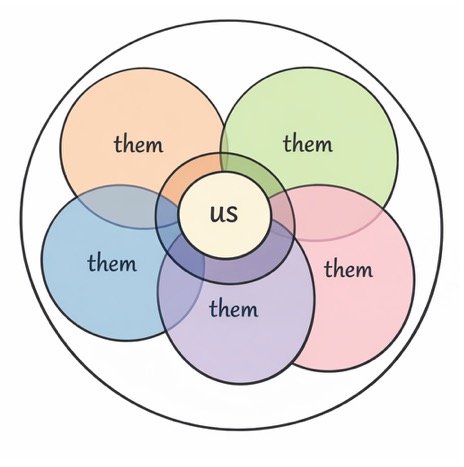 My association faced a challenge common to many if not all membership organizations: the imperative to diversify revenue sources and monetize our content expertise. Attacking that problem led to a shift in our business mindset.


 Golden's Rules for Associations