Ratiocination versus The Age of Reason
14 December 2025 Leave a comment
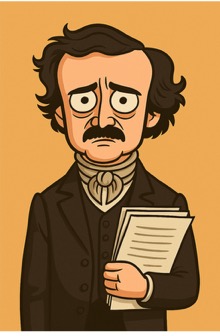 Although Edgar Allan Poe is most famous for his poetry and tales of the macabre, as an author he was so much more than that. The horror tales and poetry are but a tiny portion of a body of work extending to criticism of current events, literature, art, architecture and design; satire; historical fiction; proto-science fiction; travel narratives; and even serious mathematical[1] and scientific investigation[2].
He is, with justification, often cited as the creator of the modern detective story. His three tales featuring Auguste Dupin introduced the concept of the amateur investigator and an approach to solving mysteries (he called it “ratiocination”) that influenced nearly every writer of detective fiction since. But is there more going on here? His mysteries, and not just the Dupin stories, can also be viewed as explorations of the limits of the intellectual and scientific ideals of the Age of Reason and its dogma that reality can be fully explained purely through scientific observation and the application of human reason.
From a blog post on the Dupin stories, I found some interesting analysis, quoted from Murray Ellison’s Masters Thesis on “Poe and 19th-Century Science” (Virginia Commonwealth University, 2015). I would love to find that document to read it in its entirety, but the blog quotes it extensively, as I will also do here.
“A ratio compares the relationships between two quantities. Poe develops a new system for establishing relationships between unknown events and the motives or solutions to complex problems. Dupin expands the use of accepted nineteenth-century classical investigation techniques and adds hyper-observation and intuitive leaps of imagination to arrive at new solutions. He understands that clues and events are not always understood simply by the way that they appear.”
In his Dupin stories the formal investigative authorities represent the Enlightenment voice. Their failure to solve the crimes (which Dupin does, often from his armchair) demonstrates the limitations of their approach.
“With the same understanding of the evidence that the police hold, he provides new metaphoric solutions. His methods of unraveling crimes are unorthodox and appear to the police as irrational. Dupin presents the details of these cases directly or through an unnamed narrator to give readers a glimpse into his ratiocinative thinking … Dupin separates the relevant from the irrelevant. He focuses on unexplained deviations from the normal, anticipates the actions and thoughts of his associates and opponents, and embraces information that, at first, appears to be external to the case.”
“As a non-professional detective, Dupin mocks the inferior crime-solving techniques of the paid Parisian police officials. The prefect appears in each of the Dupin stories and … thinks he has the perfect solution to the crime. However, Dupin is always skeptical of his approach and solutions.”
“The police are symbols for his criticisms of the professional scientists of the nineteenth century.”
Poe set the Dupin stories in Paris.
“Perhaps, he … made this choice because many French scientists and philosophers [of Poe’s time] epitomized Poe’s criticisms of these intellectual ideas of the nineteenth-century Age of Reason[3]. They rejected dogma and sought ways to find objective knowledge. They believed that truth could be best be verified by observation and scientific investigation. Among the ideas that Poe attacked in his detective stories was the irrational belief that man could ultimately attain near stages of perfection, and that he could control his environment [entirely] by scientific methods. Because of these contradictory views, it is hard to determine if Poe proposed ratiocination to address crime, or if he was mocking the irrational faith that the Age of Reason thinkers had in science.”
No one familiar with the vast range of Poe’s corpus of work would make the mistake of concluding that he was opposed to science and reason. His scientific writing is notably rational and often prescient. He even often used fiction to expose scientific hoaxes of his day and to provide well-reasoned explanations of the actual, scientific truth.
“In his three tales of ratiocination, Poe demonstrates that Dupin’s methods of scientific reasoning are superior to those of the police. He is critical of the established authorities and power structures. … He believes that scientists [of his time] are limited in arriving at new solutions in the same ways that the police are limited in solving crimes.”
So, his view seems to be that while science and reason are critical, science and reason alone are insufficient. It takes a spark of genius that goes beyond mere observation and reason. Poe isn’t anti-science or anti-reason. He merely seems to have viewed that too absolute a reliance on the science of his day leaves important variables out of the equation.
Science has advanced mightily since the mid-19th century. The fruits of scientific observation and reasoning are accumulative and provide a far sturdier foundation for what is demonstrably knowable to work from, making it easier to avoid any shortcomings of the past. Perhaps his views are relevant only to a critique of the limited state that science had reached in his own day.
But one wonders what Poe would make of the state (and limits) of scientific advancement achieved today. And what hobby horses of hubris and limited thought would be the target of his critical skewers?
While generative AI has been used to create the accompanying graphic, I do not use AI tools in composing the content.
[1] Among his earliest paid journalism was a cryptography challenge, boasting that he could break any coded message submitted by the paper’s readers. “He received nearly a hundred secret messages from all over the country. Poe solved them all, except for one. And that coded message he proved to be ‘an imposition,’ a jumble of ‘random characters having no meaning whatever.’” (A Love of Mystery Is Woven into our Biology, and Edgar Allan Poe was the First to Find the Formula for a Very Specific Dopamine Hit.)
[2] Poe’s “Eureka” (1848) posits that the universe began from a singular, unified state and expanded over time, long before the formal development of the Big Bang model. Later scientific discoveries moot nearly all the details. He got “what happened” wrong, but some of Poe’s concepts align surprisingly well with modern cosmology.
[3] There is an alternative possibility. The source article also observes that Matthew Pearl, in his “Introduction” to the Dupin Mysteries, notes that “Poe introduced Detective C. Auguste Dupin, of Paris, France to literature more than five years before Boston had established the [United States’] first professional police department.”
 About Mark J. Golden, FASAE, CAE



 Golden's Rules for Associations